
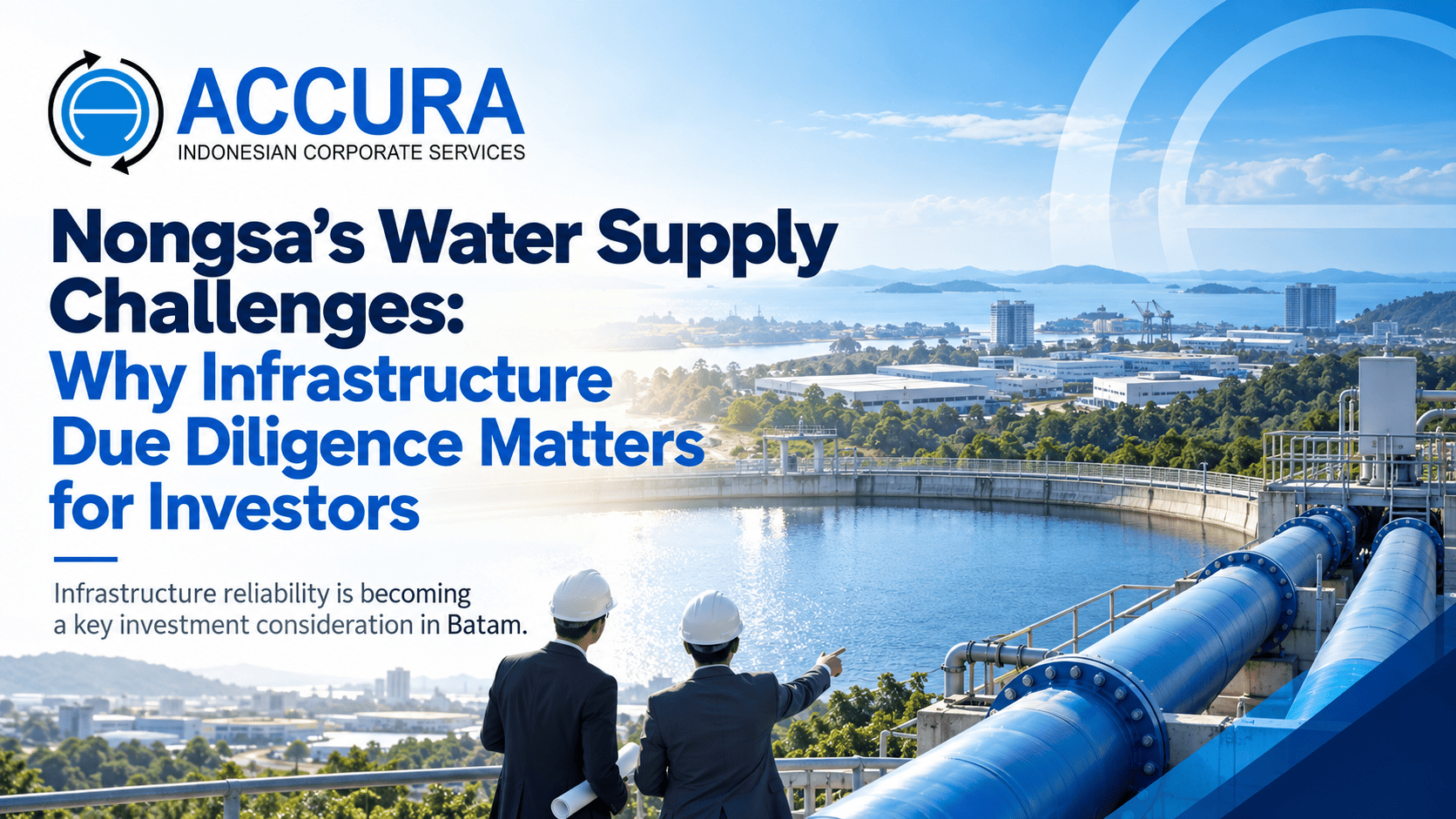
Nongsa is emerging as one of Batam's strategic investment destinations, particularly for digital infrastructure, data centers, technology businesses, and tourism-related developments.
Its proximity to Singapore, growing digital ecosystem, and Special Economic Zone (SEZ) status have positioned the area as an attractive destination for international companies seeking expansion opportunities in Indonesia.
However, recent developments have highlighted an important investment consideration: business growth must be supported by reliable physical infrastructure.
In September and October 2026, Nongsa experienced significant pressure on its water supply as declining reservoir levels affected treatment capacity and distribution reliability.
For foreign investors, the situation offers an important lesson. Investment decisions should extend beyond location advantages, regulatory incentives, and projected market growth to include detailed assessments of infrastructure capacity, resource security, and business continuity.
1. Nongsa's Water Supply Situation in October 2026
According to BP Batam, declining rainfall has significantly affected raw water availability in Nongsa, reducing the capacity of the local water supply system.
During an inspection on October 5, 2026, BP Batam Chairman Amsakar Achmad reported the following conditions:
| Indicator | Reported Condition |
| Normal reservoir water level | Approximately 10 meters |
| Water level on October 5, 2026 | Approximately 5.5 meters |
| Decline from normal level | Approximately 4.5 meters |
| Nongsa treatment plant operating capacity on October 13 | 18.75% |
| Main contributing factor | Low rainfall and declining raw water availability |
Water-level figures refer to reported reservoir elevation, not the percentage of usable water storage. The treatment plant operating figure is from BP Batam's October 13 update.
BP Batam confirmed that reduced rainfall had lowered inflows into Nongsa Reservoir, affecting water production and distribution to surrounding communities.
A separate citywide electricity disruption on October 12 also interrupted water treatment and distribution operations in Batam. By October 13, approximately 80% of customer service areas had begun receiving water again, although Nongsa's treatment plant remained constrained by low reservoir levels.
These developments demonstrate how water availability, electricity reliability, and distribution infrastructure can interact to affect essential services.
Official sources:
BP Batam — Nongsa Reservoir Inspection, October 6, 2026BP Batam — Water Distribution Recovery Update, October 13, 2026
2. Why Nongsa's Water Challenges Matter for Foreign Investors
Nongsa is not simply a residential and tourism destination. It is also part of Batam's expanding digital investment ecosystem.
According to Indonesia's National Council for Special Economic Zones, Nongsa SEZ covers approximately 166.45 hectares and was established under Government Regulation No. 68 of 2021.
The zone supports activities including digital technology, data processing, education, tourism, and technology development.
As investment activity expands, water infrastructure becomes increasingly relevant to commercial feasibility.
Operational continuity and business disruption
Reliable water access supports a wide range of commercial activities.
For hospitality operators, interruptions may affect accommodation services, sanitation, and customer experience.
For industrial facilities, inadequate water availability may disrupt cleaning processes, cooling, equipment maintenance, or other operational activities.
Data center operators must also evaluate their cooling technologies, water consumption requirements, and backup infrastructure.
The level of exposure varies by business model. Not every data center requires the same volume of water, and operational demand depends on the cooling system selected.
Nevertheless, investors should establish whether sufficient water can be delivered consistently under normal and adverse conditions.
Infrastructure constraints can increase operating costs
Water shortages may require businesses to invest in additional infrastructure, including onsite storage, backup supply arrangements, water recycling systems, or alternative treatment technologies.
These requirements can affect initial capital expenditure, ongoing operating costs, and project profitability.
For investors preparing financial forecasts, water infrastructure should therefore be considered an essential operating assumption rather than a secondary facility requirement.
Environmental and community considerations
Water availability is also becoming an important sustainability consideration.
Projects that require substantial water resources may face greater scrutiny regarding their potential impact on surrounding communities.
Investors should evaluate not only whether adequate water is available for their operations, but also whether their proposed supply arrangements are sustainable and socially responsible.
Importantly, BP Batam has attributed the recent Nongsa reservoir decline primarily to limited rainfall. The official reports cited here do not establish that data center consumption caused the shortage.
3. How BP Batam Is Responding to Water Supply Challenges
BP Batam and its water service partners have introduced technical measures intended to improve distribution reliability and strengthen water availability in Nongsa.
Pipeline interconnection and distribution improvements
In October 2026, BP Batam announced interconnection works involving the Duriangkang water supply system and Nongsa's distribution network.
The measures include connecting sections of distribution pipelines and optimizing booster systems to improve water delivery.
BP Batam also reported work to transfer additional raw water from a retention pond in the Nongsa Botanical Garden area to Nongsa Reservoir.
On October 9, the authority confirmed that interconnection improvements were being implemented, alongside continued water tanker assistance for affected communities.
Further Short-Term Improvements
On October 13, 2026, PT Air Batam Hilir (ABHi), a water utility company responsible for treated-water distribution and customer services in Batam, announced additional measures to address water supply disruptions in Nongsa.
Working alongside BP Batam's Water Supply System Management Unit (BU SPAM), the company outlined technical improvements in the Renggali area of Nongsa. The short-term works were expected to begin shortly and take approximately ten days.
These coordinated efforts demonstrate the authorities' and water service provider's commitment to improving supply reliability. However, investors should distinguish between short-term mitigation measures and long-term infrastructure readiness.
Before making investment commitments, businesses should obtain updated technical assessments and confirm water supply capacity directly with the relevant utility providers.
Official Source: PT Air Batam Hilir — Water Supply Mitigation Efforts in Nongsa, October 13, 2026
4. Seawater Desalination: An Emerging Infrastructure Opportunity
One of the most significant developments for Batam's industrial investment environment is the increasing emphasis on seawater desalination.
In September 2026, BP Batam encouraged data center operators, particularly in Nongsa and Kabil, to develop independent water supply systems using Seawater Reverse Osmosis (SWRO) technology.
SWRO converts seawater into usable freshwater through a desalination process.
The initiative aims to support industrial investment while reducing pressure on reservoir supplies intended for residential communities.
According to the Batam City Government's September 25 announcement, projected SWRO capacity additions include:
|
Initial projected capacity 750 L/sLiters per second |
Longer-term target 1,000 L/sLiters per second |
The policy direction creates potential business opportunities for companies specializing in water treatment technology, desalination systems, industrial engineering, and sustainable utility infrastructure.
It also introduces additional feasibility considerations for prospective data center developers, including desalination investment costs, energy consumption, environmental requirements, and long-term operating arrangements.
Investors should verify applicable project-specific obligations rather than assuming that a public policy announcement alone establishes every legal requirement.
Official source: Batam City Government — SWRO Development for Data Centers, September 25, 2026
5. Infrastructure Due Diligence: What Investors Should Evaluate
Before acquiring land, establishing operations, or committing to infrastructure-intensive developments, investors should conduct comprehensive infrastructure due diligence.
The following assessments are particularly relevant to projects in Nongsa and other rapidly developing areas of Batam:
1. Water supply availability and capacity. Verify existing water sources, confirmed supply allocations, daily requirements, and whether infrastructure can accommodate future expansion. Obtain information directly from relevant operators rather than relying exclusively on promotional materials.
2. Distribution network reliability. Examine pipeline capacity, delivery pressure, pumping systems, previous disruptions, and the availability of alternative supply routes.
3. Backup infrastructure and contingency planning. Evaluate onsite water storage, emergency supply arrangements, operational continuity procedures, and the financial implications of prolonged service interruptions.
4. Environmental and regulatory compliance. Identify applicable environmental approvals, water-related requirements, wastewater management obligations, and any additional permits associated with alternative water treatment or desalination facilities.
5. Long-term operating costs. Include water infrastructure investments, treatment expenses, utility consumption, maintenance requirements, and potential supply-related disruptions in financial projections.
6. Stakeholder coordination and infrastructure development timelines. Confirm proposed infrastructure upgrades, project delivery responsibilities, expected completion dates, and relevant contractual commitments with estate developers, utilities, and authorities.
These assessments can help investors identify operational vulnerabilities before major financial commitments are made.
They also support more realistic project planning and reduce the likelihood of unexpected infrastructure-related costs.
6. What Nongsa's Water Challenges Mean for Investment Strategy
Nongsa's water supply difficulties should not automatically be interpreted as evidence that the area is unsuitable for investment.
Instead, they illustrate the importance of aligning investment expansion with infrastructure development.
Batam continues to offer geographic and commercial advantages, particularly through its proximity to Singapore and growing digital economy.
However, successful market entry depends on whether essential infrastructure can support a project's specific operating requirements.
For foreign investors, three strategic considerations stand out.
First, site selection must be based on verified infrastructure conditions. Two sites within the same investment area may have different utility connections, pressure reliability, and expansion capacity.
Second, investment timelines should reflect infrastructure readiness. Planned improvements may increase future capacity, but investors should distinguish announced targets from completed and operational facilities.
Third, sustainable infrastructure can create competitive advantages. Companies capable of implementing efficient water systems, resource monitoring, and responsible operating practices may be better positioned to manage long-term risks.
As Batam attracts more infrastructure-intensive investment, operational resilience is likely to become an increasingly important differentiator.
7. How ACCURA Supports Infrastructure-Aware Market Entry in Indonesia
Investing in Indonesia requires more than identifying an attractive market.
Foreign companies must also understand business establishment requirements, licensing obligations, local operating conditions, and potential implementation risks.
At ACCURA, we help international businesses navigate the practical complexities of entering and operating in Indonesia.
Our support includes business establishment, regulatory and licensing assistance, market entry planning, and coordination of local operational requirements.
For investors evaluating opportunities in Batam, an infrastructure-aware approach can help ensure that commercial plans are aligned with regulatory requirements and the realities of local operations.
Where specialized infrastructure assessments are required, these should be supported by qualified technical professionals and relevant utility providers.
Conclusion: Infrastructure Readiness Is Essential to Sustainable Investment
Nongsa's water supply challenges in 2026 highlight a broader investment lesson: strong market potential does not eliminate infrastructure risk.
The decline in Nongsa Reservoir levels, resulting distribution pressures, and ongoing mitigation efforts demonstrate why investors must carefully assess essential utility availability before making long-term commitments.
Meanwhile, BP Batam's desalination initiatives indicate an effort to support future industrial growth while protecting the water needs of local communities.
For international investors, the priority should not simply be identifying where opportunities exist, but determining whether the operational foundations required to support those opportunities are sufficiently reliable.
Infrastructure due diligence is therefore not just a risk-management exercise. It is an essential part of building a sustainable and commercially viable investment strategy.
Ready to Invest in Batam? Start with the Right Local Partner.
Entering Indonesia's growing investment market requires clear regulatory planning, informed business decisions, and a practical understanding of local operating conditions.
ACCURA helps foreign investors navigate company establishment, business licensing, market entry, and operational requirements in Indonesia.
Whether you are considering opportunities in Nongsa, Batam's industrial estates, or other strategic investment locations, our team can help you build a clearer path to market entry.
Turn investment opportunities into well-planned business operations.