
Indonesia's healthcare sector is creating new opportunities for international medical suppliers, and Batam is positioning itself to participate in this development.
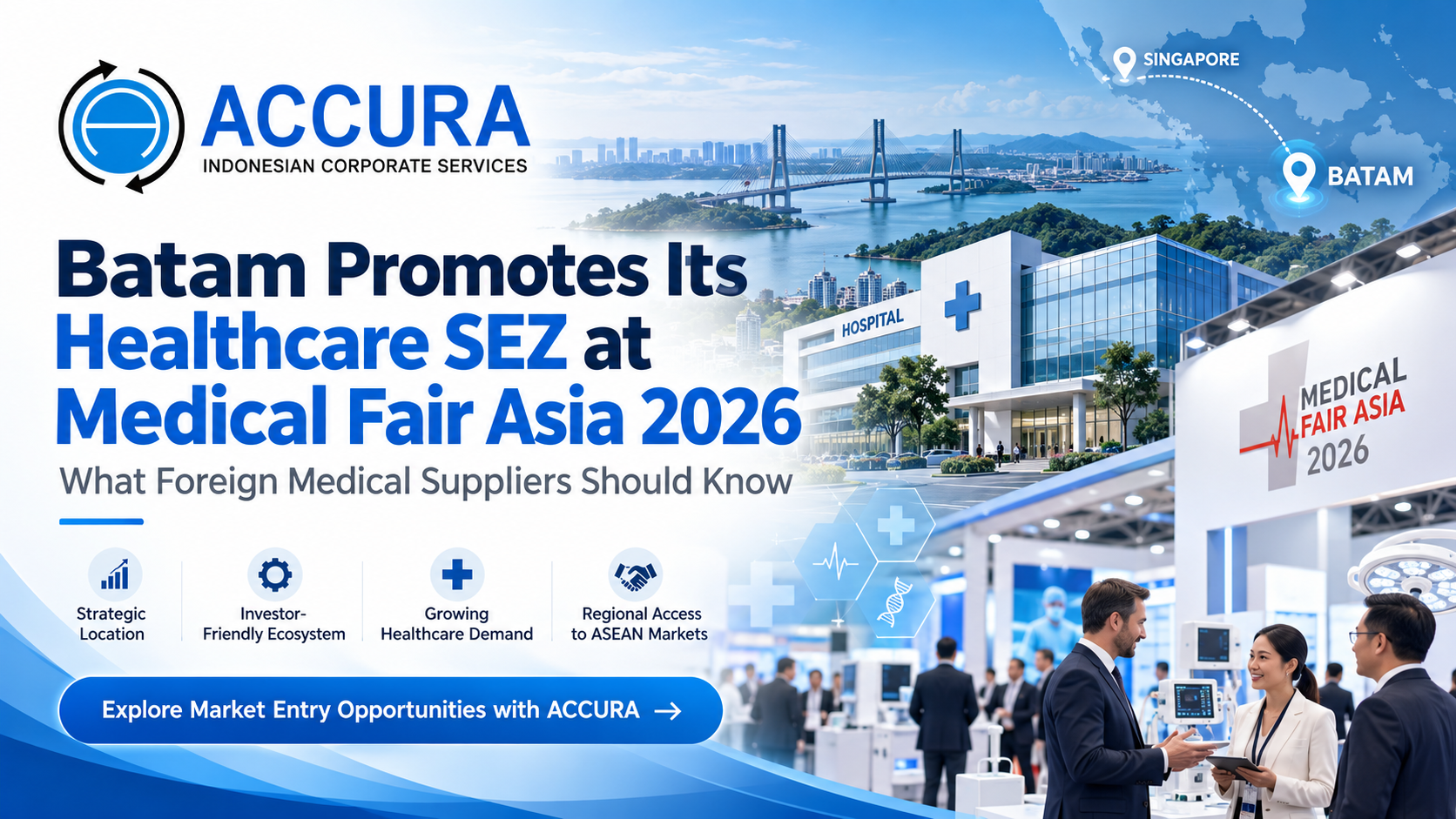
From 9–11 September 2026, BP Batam participated in Medical Fair Asia 2026 at Marina Bay Sands, Singapore, promoting investment opportunities in the Batam International Health Tourism Special Economic Zone (SEZ).
The event, organized by Messe Düsseldorf Asia, brought together international companies involved in medical equipment, healthcare technology, diagnostics, pharmaceuticals, and healthcare services.
According to BP Batam's official announcement dated 11 September 2026, the participation was intended to strengthen international investment connections and introduce Batam's healthcare development plans to potential partners.
Dendi Gustinandar, BP Batam's Director of Investment Promotion and Facilitation, also participated as a speaker in the Market Entry Briefing: Indonesia session, highlighting opportunities in Indonesia's healthcare sector and Batam's potential as an investment destination.
For foreign medical equipment manufacturers and healthcare technology companies, the development raises an important question:
Could Batam's emerging healthcare ecosystem create a practical entry point into Indonesia's medical device market?
The opportunity is worth examining, but suppliers need to distinguish long-term investment potential from immediate commercial readiness.
1. Understanding Batam's Healthcare Special Economic Zone
Batam's healthcare ambitions are supported by an officially designated Special Economic Zone.
On 7 October 2024, the Indonesian government enacted Government Regulation No. 39 of 2024, establishing the Batam International Tourism and Health Special Economic Zone.
The regulation designates approximately 47.17 hectares across Sekupang and Nongsa for tourism and healthcare activities.
The development is intended to support an integrated ecosystem combining healthcare services, medical tourism, and supporting commercial activities.
According to BP Batam, the broader development plan includes several important components:
-
International-standard hospital facilities.
-
Healthcare-related training and education.
-
Medical technology and supporting infrastructure.
-
Hospitality, accommodation, and medical tourism services.
BP Batam has identified the planned Mayapada Apollo Batam International Hospital, a proposed MedTech Park, and the modernization of RSBP Batam as important elements of this ecosystem.
Earlier government projections placed the SEZ's targeted investment at approximately IDR 6.91 trillion. However, this figure represents an investment target, not confirmed realized investment.
What is the latest development status?
Foreign suppliers should pay attention to the project's actual implementation schedule.
On 24 September 2026, BP Batam reported progress in land preparation for the Mayapada Apollo Batam International Hospital project.
At that time, approximately 1.6 hectares had been prepared for the hospital's main building, while additional supporting land remained under preparation.
BP Batam's investment officials indicated that physical construction was expected to begin in November 2026, with project completion targeted for 2027. The hospital project was estimated at approximately IDR 1.7 trillion.
These developments suggest that Batam's healthcare SEZ is an emerging investment ecosystem rather than a fully operational international medical hub.
For suppliers, this distinction matters. Commercial opportunities may arise during project planning, construction, equipment procurement, facility commissioning, and eventual healthcare operations.
2. Why Medical Fair Asia 2026 Matters for Foreign Medical Suppliers
BP Batam's participation in Medical Fair Asia 2026 reflects an effort to connect regional healthcare investment plans with international manufacturers and service providers.
The exhibition's organizer promoted the event as a platform connecting businesses across hospital equipment, diagnostics, medical technology, rehabilitation, and other healthcare industries.
By participating in the event and presenting its investment prospects, BP Batam introduced the healthcare SEZ to companies that may be evaluating Southeast Asian expansion strategies.
For international suppliers, three strategic considerations stand out.
A. Early access to an emerging healthcare ecosystem
Large healthcare developments can generate demand for medical equipment, clinical infrastructure, diagnostic technologies, and associated services.
Suppliers that engage during the development stage may have opportunities to understand technical specifications, identify project stakeholders, and prepare for future procurement processes.
However, participation in an international exhibition does not guarantee procurement contracts or supplier appointments.
B. A potential connection to Indonesia's wider healthcare market
Batam is geographically close to Singapore and forms part of an established regional business and industrial network.
For international manufacturers, this location may offer practical advantages for business meetings, regional coordination, and partner engagement.
Nevertheless, commercial distribution into Indonesia remains subject to Indonesian licensing, customs, and medical device regulatory requirements.
C. Opportunities beyond equipment sales
Healthcare facilities require more than an initial supply of medical devices.
Long-term operations can also create requirements for equipment installation, user training, maintenance, spare parts, technical support, and ongoing product compliance.
International companies should therefore consider a service-oriented market strategy rather than focusing exclusively on one-time equipment transactions.
3. Which Medical Suppliers Could Benefit from Batam's Healthcare Expansion?
Several medical technology and healthcare supply segments may be relevant to the SEZ's planned development.
Hospital equipment and clinical technology
Future hospital developments may require patient monitoring systems, non-radiation electromedical equipment, surgical instruments, clinical furniture, and supporting hospital technologies.
Actual procurement requirements will depend on confirmed facility designs, clinical specialties, budgets, and procurement schedules.
In vitro diagnostics and laboratory systems
International healthcare facilities typically require laboratory testing capabilities. This creates potential opportunities for IVD manufacturers, laboratory equipment suppliers, and diagnostic technology providers.
Suppliers should assess product classification, registration requirements, and technical support capacity before pursuing commercial arrangements.
Sterile and non-sterile medical devices
Hospitals and healthcare facilities require medical consumables and equipment for routine clinical activities and specialized procedures.
Foreign manufacturers may evaluate opportunities to introduce suitable products through authorized Indonesian commercial channels.
Medical technology services and support
Healthcare expansion may also support demand for installation services, equipment maintenance, calibration, technical training, and healthcare operational solutions.
These are potential market segments—not confirmed purchasing commitments from the Batam healthcare SEZ.
The key opportunity is to understand which products and services align with actual healthcare development needs.
4. What Foreign Medical Suppliers Must Know About Indonesia's Regulations
Entering Indonesia's medical device market requires a structured regulatory and operational approach.
Even when a prospective customer operates within a Special Economic Zone, foreign suppliers should not assume that SEZ status automatically removes medical device registration or distribution requirements.
Medical device registration and marketing authorization
Medical devices intended for commercial distribution in Indonesia are generally subject to marketing authorization requirements administered by the Ministry of Health.
Indonesia's regulatory framework includes Minister of Health Regulation No. 11 of 2025, governing business licensing and product/service standards within the healthcare subsector.
Additionally, Minister of Health Regulation No. 5 of 2026 on Health Supplies, effective from May 2026, provides updated provisions governing health supplies, including medical devices and their distribution.
Foreign manufacturers should evaluate the appropriate regulatory pathway for each product before beginning commercial distribution.
Establishing an appropriate local distribution arrangement
Suppliers generally need to determine how their products will be imported, registered, and distributed through legally authorized Indonesian entities.
Depending on the activities involved, relevant requirements may include:
-
Business licensing through Indonesia's OSS system.
-
An appropriate business classification and distribution authorization.
-
Medical device marketing authorization (Izin Edar).
-
Applicable good distribution practice requirements.
-
Import documentation, technical compliance, and post-market obligations.
The Ministry of Health operates the official Regalkes registration system and Info Alkes verification platform to support registration and public verification of medical device authorizations.
Understanding Indonesia's updated business licensing framework
Indonesia introduced Government Regulation No. 28 of 2025 on Risk-Based Business Licensing, replacing Government Regulation No. 5 of 2021.
Companies planning distribution, importation, or local business operations should ensure their licensing structure is evaluated against the current framework and applicable business classifications.
This is particularly important for foreign companies evaluating whether to appoint a local distributor, collaborate with a market-entry partner, or establish their own Indonesian entity.
SEZ incentives do not eliminate regulatory obligations
Indonesia's SEZ framework provides for investment-related facilities and incentives, subject to qualifying activities and applicable regulations.
However, commercial arrangements involving the Batam healthcare SEZ must distinguish between SEZ-specific customs or investment facilities and the requirements applicable to products entering Indonesia's domestic market.
Government Regulation No. 39 of 2024 also distinguishes the designated healthcare SEZ territory from Batam's wider Free Trade and Free Port Zone framework.
For medical suppliers, the correct approach is to review the intended goods movement, importing entity, destination, and applicable medical device authorization requirements before making commercial commitments.
5. How Foreign Suppliers Can Prepare for Batam's Healthcare Opportunities
The development of Batam's healthcare SEZ offers a reason to evaluate Indonesia, but suppliers should translate that opportunity into a practical market-entry strategy.
Step 1: Assess product-market suitability
Evaluate which products could meet the requirements of emerging healthcare facilities in Batam and other Indonesian markets.
Consider clinical applications, target customers, competitor positioning, pricing, and technical support requirements.
Step 2: Identify the regulatory pathway
Determine each product's Indonesian classification and registration requirements.
Manufacturers should prepare relevant technical documentation and clarify the responsibilities of the manufacturer, authorized local distributor, and marketing authorization holder.
Step 3: Prepare local import and distribution operations
Review the appropriate importing arrangement, distribution model, logistics structure, and ongoing compliance obligations.
A reliable operational model can help reduce avoidable delays between regulatory approval and commercial availability.
Step 4: Develop relationships with potential healthcare customers
Engage relevant hospitals, healthcare operators, project developers, and purchasing stakeholders.
At the same time, confirm whether proposed developments have reached procurement or operational stages before allocating significant commercial resources.
Step 5: Build an Indonesian market presence
Commercial expansion often requires local sales representatives, product education, customer follow-up, and ongoing technical coordination.
Foreign suppliers should evaluate how to establish these functions while maintaining appropriate oversight of their product portfolios and business relationships.
6. From Healthcare Investment Opportunities to Market Entry: How ACCURA Can Help
A promising healthcare market is only valuable when foreign suppliers can establish a practical route to customers.
For medical device manufacturers seeking expansion into Indonesia, identifying investment opportunities is often the first step.
The next challenge is navigating regulatory requirements, coordinating imports, establishing local operations, and developing commercial relationships.
ACCURA Indonesia supports international medical device principals through an integrated approach to Indonesian market entry.
Regulatory & Market Entry Support
ACCURA assists suitable medical device suppliers with market-entry assessments, product registration coordination, and local regulatory requirements.
Import & Local Operations
ACCURA helps coordinate the local operational processes required to move products toward commercial availability, subject to applicable approvals and compliance obligations.
Sales & Marketing Support
ACCURA can support market development through local sales and marketing resources, customer engagement, and commercial coordination.
Rather than requiring every international manufacturer to build its own local infrastructure from the beginning, ACCURA provides access to complementary local capabilities tailored to the supplier's objectives.
This approach is particularly relevant to international medical device companies seeking to explore Indonesia while retaining strategic control over their products, brand positioning, and commercial direction.
7. Frequently Asked Questions
Is Batam's healthcare SEZ already operational?
The SEZ was legally established in October 2024, but its major planned healthcare developments are progressing through different stages. As of September 2026, Mayapada Apollo Batam International Hospital was still preparing for physical construction, with completion targeted for 2027.
Can foreign medical manufacturers sell products in Indonesia without a local distributor?
The appropriate structure depends on the manufacturer's business model and applicable Indonesian licensing requirements. Companies must establish a compliant arrangement for importation, marketing authorization, and distribution before undertaking regulated commercial activities.
Does the Batam healthcare SEZ automatically exempt imported medical devices from registration?
No general exemption should be assumed. SEZ-related facilities and product regulatory approvals are separate matters. Suppliers must verify the requirements applicable to their intended products and transactions.
What types of medical devices does ACCURA support?
ACCURA's medical device market-entry offering focuses on non-radiation electromedical devices, sterile and non-sterile non-electromedical devices, and in vitro diagnostics. Product suitability and regulatory requirements are assessed individually.
Conclusion: Batam's Healthcare Expansion Creates Opportunities for Prepared Suppliers
Batam's participation in Medical Fair Asia 2026 reinforces its ambition to develop a more internationally connected healthcare ecosystem.
The establishment of the Batam International Tourism and Health SEZ, together with planned hospital and supporting infrastructure investments, provides foreign medical suppliers with potential opportunities to explore.
However, the success of a supplier's Indonesian expansion will depend on more than the announcement of new healthcare facilities.
Regulatory readiness, reliable import arrangements, local commercial capabilities, and an understanding of actual project development timelines are essential.
For foreign medical suppliers, the question is not simply whether Batam's healthcare market will grow, but whether their business is prepared to enter Indonesia when the right opportunities emerge.
Ready to Enter Indonesia's Medical Device Market?
Your Market. Your Brand. Your Control.
ACCURA Indonesia helps international medical device manufacturers and suppliers evaluate market-entry opportunities, coordinate regulatory and import requirements, and develop local commercial capabilities.
Whether your company is exploring future healthcare projects in Batam or preparing for broader expansion across Indonesia, ACCURA can help you assess the next steps.
ENTER INDONESIA WITHOUT BUILDING EVERYTHING FROM SCRATCH.
Explore our medical device market-entry services and request an initial assessment of your product portfolio.
Official Sources & References
Berikut referensi utama yang dapat dicantumkan pada halaman artikel ACCURA.
1. BP Batam — 11 September 2026. BP Batam Promotes the International Health Tourism SEZ at Medical Fair Asia 2026. Sumber utama kegiatan dan pernyataan BP Batam.
2. Medical Fair Asia — Messe Düsseldorf Asia. Medical Fair Asia 2026 Event Overview. Jadwal, penyelenggara, lokasi, dan cakupan industri peserta.
3. Government of Indonesia — Government Regulation No. 39 of 2024. Establishment of Batam International Tourism and Health SEZ. Dasar hukum, lokasi, dan luas kawasan KEK.
4. BP Batam — Healthcare SEZ Development. Batam Healthcare SEZ Investment Development. Referensi target investasi dan rencana pengembangan.
5. ANTARA — 24 September 2026. BP Batam Confirms Progress on Mayapada Apollo Hospital Site. Laporan terbaru yang mengutip pejabat BP Batam tentang kesiapan lahan, jadwal pembangunan, dan target penyelesaian.
6. Ministry of Health — Ministerial Regulation No. 11 of 2025. Healthcare Risk-Based Business Licensing Standards. Ketentuan perizinan subsektor kesehatan.
7. Ministry of Health — Ministerial Regulation No. 5 of 2026. Health Supplies Regulation 2026. Regulasi terbaru terkait perbekalan kesehatan, peredaran, dan distribusi.
8. Government of Indonesia — Government Regulation No. 28 of 2025. Risk-Based Business Licensing Regulation. Kerangka perizinan berusaha berbasis risiko yang berlaku.
Research cutoff: 12 October 2026. Investment figures and project completion dates are identified as targets or estimates where applicable, not as completed investments or operating facilities.