
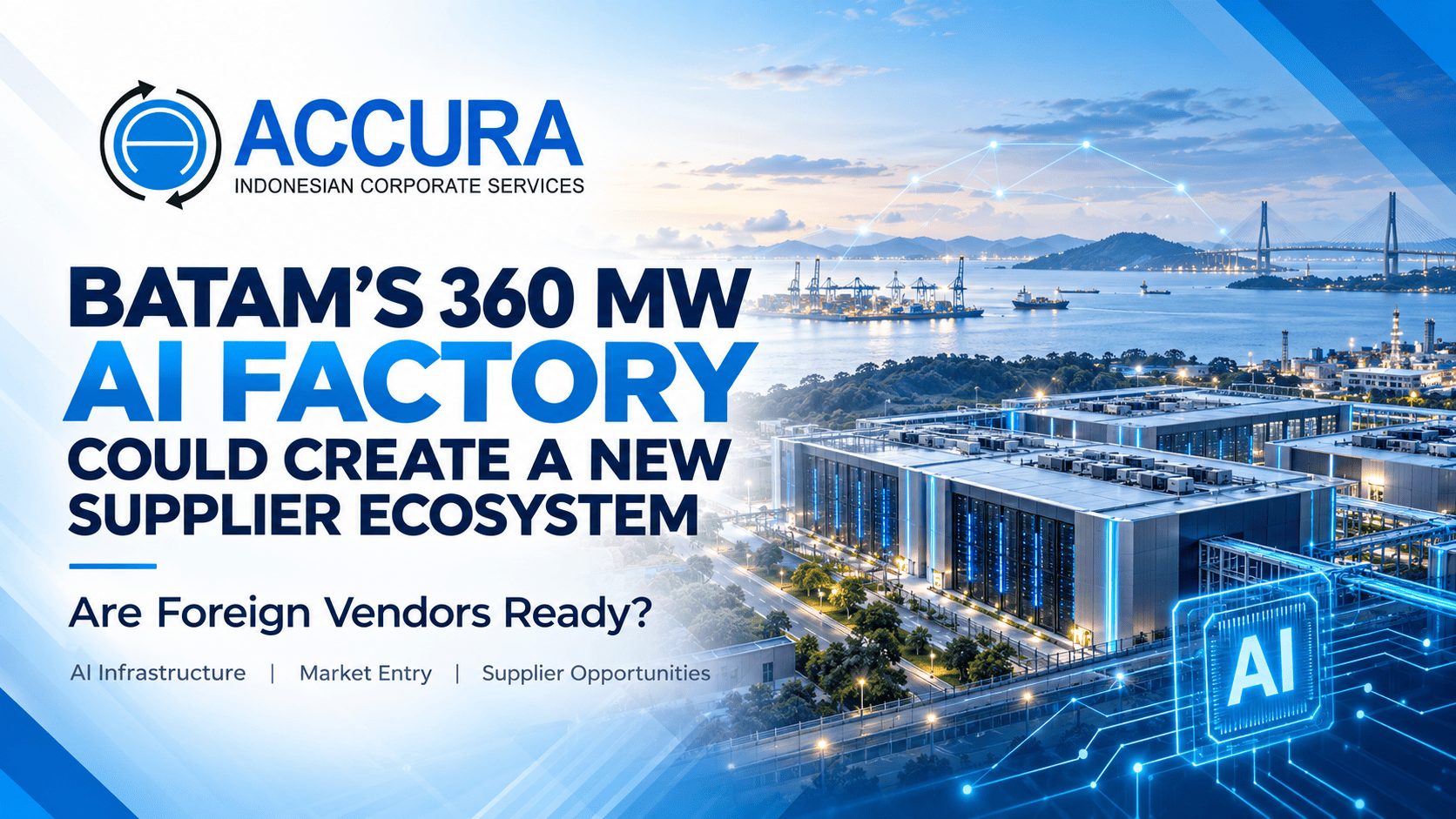
Batam Is Entering a Different Scale of Digital Infrastructure
Batam has spent decades building a reputation as an industrial and manufacturing base close to Singapore.
The next phase may look very different.
In June 2026, Australian AI infrastructure company Firmus Technologies announced a strategic compute partnership with NVIDIA running through 2034, anchored by a dedicated 360 MW NVIDIA DSX AI Factory campus in Batam.
According to Firmus, the agreement covers up to 170,000 NVIDIA AI accelerators across NVIDIA Grace Blackwell, Vera Rubin and Vera platforms during 2027–2028. The company expects between US$25 billion and US$30 billion in committed offtake agreements during the first six years of the partnership. The Batam campus is being developed in partnership with Singapore-headquartered data-center platform DayOne. Firmus
NVIDIA has separately confirmed that Firmus is building a DSX AI factory campus in Batam expected to scale to 360 MW and up to 170,000 NVIDIA GPUs. NVIDIA Blog
BP Batam has also publicly supported the project and says operations are targeted to begin in Q1 2027. BP Batam
This matters because a project at this scale is not simply another data center.
It has the potential to generate an entire infrastructure and supplier ecosystem around it.
What Exactly Is an “AI Factory”?
Traditional data centers are designed primarily to store, process and distribute digital information.
AI factories operate under a much more demanding infrastructure model.
NVIDIA describes its DSX platform as a full-stack architecture covering facilities infrastructure, accelerated computing, networking, software and operational systems. NVIDIA says AI factories must coordinate infrastructure across layers including energy, chips, facilities, models and applications. NVIDIA Developer
For the Batam development specifically, Firmus says its proprietary HyperCube liquid-cooled AI Factory architecture will be integrated with NVIDIA DSX blueprints. Firmus
That distinction is critical for suppliers.
A high-density AI campus supporting tens of thousands of accelerators can create demand not only for computing hardware, but for:
- high-voltage electrical infrastructure, UPS systems, switchgear and backup power;
- liquid-cooling systems, heat exchangers, pumps and thermal-management equipment;
- racks, servers, storage and high-speed networking;
- fiber-optic and interconnection infrastructure;
- cybersecurity and data-center management systems;
- MEP engineering, construction and commissioning;
- industrial water and water-treatment systems;
- monitoring, fire protection and physical security;
- logistics, maintenance, testing and technical field services; and
- highly specialized engineering and operational talent.
These should be viewed as potential supplier categories generated by the technical requirements of an AI factory, rather than confirmed procurement packages for the Firmus project. No complete public supplier tender list for the Batam campus has been announced.
And the opportunity may extend considerably beyond this single development.
The 360 MW Campus Is Part of a Much Larger Batam Data-Center Pipeline
One of the most important developments for foreign suppliers came in September 2026.
BP Batam reported that the combined existing, committed and pipeline capacity of Batam’s data-center industry had reached approximately 1.47 GW of IT capacity. PTSP Batam
That figure changes the market-entry calculation.
A vendor considering Batam should not necessarily evaluate the market based on one NVIDIA-related project. The commercial question is whether Batam is developing enough infrastructure concentration to support a lasting local supplier base.
Evidence increasingly points in that direction.
DayOne, for example, signed a 511 MVA power purchase agreement—equivalent to approximately 450 MW of grid capacity—with PLN Batam in April 2026 for its Kabil Industrial Tech Park campus. Power is scheduled to be supplied in phases during 2026–2027. Day One
BP Batam also announced another high-density AI data-center project in May 2026 involving PT Equator Gate System Batam, backed by China-based Range IDC, with a reported investment value of around US$5 billion across approximately 30 hectares in Teluk Mata Ikan, Nongsa. PTSP Batam
This means suppliers entering Batam may ultimately be targeting an emerging cluster, rather than an isolated customer.
Electricity Is Becoming One of Batam’s Most Important Infrastructure Markets
AI infrastructure is extraordinarily power-intensive.
And Batam authorities are already planning around that reality.
In September 2026, BP Batam said PLN Batam expects the island's peak electricity demand to rise from approximately 841 MW in 2026 to 2,540 MW by 2035, while planned available supply capacity is expected to increase to around 3,691 MW. PTSP Batam
BP Batam is now promoting what it calls a “Utility First, Investment Follows” approach, emphasizing five priorities:
competitive electricity tariffs, supply reliability, faster infrastructure construction, water resilience, and integration between investment expansion and utility capacity. PTSP Batam
For equipment manufacturers and engineering companies, this has potentially significant implications.
The addressable ecosystem could include not only equipment installed inside data centers, but also the infrastructure supporting them—from substations and grid connections to power management, transmission equipment, energy efficiency and potentially renewable-energy integration.
For foreign vendors, therefore, Batam's AI opportunity may be as much an energy-infrastructure story as a computing story.
Cooling and Water Infrastructure Could Become Another Major Supplier Segment
AI racks can operate at power densities far beyond conventional enterprise servers.
That increases cooling requirements considerably.
Firmus has already stated that the Batam AI Factory will integrate its liquid-cooled HyperCube architecture with the NVIDIA DSX platform. Firmus
Water management is also increasingly entering Batam's data-center policy discussion.
In September, BP Batam publicly encouraged data-center developments—particularly around Kabil and the Nongsa Special Economic Zone—to develop independent Sea Water Reverse Osmosis (SWRO) facilities rather than relying on reservoir water intended for Batam residents.
BP Batam's leadership said data-center investments should provide their own SWRO systems for operational water requirements. PTSP Batam
For international companies specializing in:
industrial desalination, water purification, cooling towers, closed-loop cooling, heat rejection, pumps, valves, monitoring systems or thermal engineering,
Batam's digital infrastructure expansion could therefore generate a second-tier opportunity that is easily overlooked when attention is focused only on GPU procurement.
Batam Is Also Strengthening Its Connectivity to Singapore
Power alone does not create an AI infrastructure hub.
Connectivity matters equally.
In July 2026, the Nongsa–Changi Cable landed in Batam, connecting Nongsa Digital Park with Changi, Singapore through 24 pairs of optical fiber.
BP Batam says the new subsea infrastructure supports data centers, cloud computing, AI and interconnection requirements between digital facilities. PTSP Batam
This connection reinforces one of Batam's strongest advantages: its proximity to Singapore.
Singapore can remain a major regional headquarters, cloud and financial-services hub, while Batam increasingly provides space, infrastructure and operating capacity immediately across the Singapore Strait.
That regional relationship may create opportunities for international infrastructure companies already servicing Singapore-based clients to extend operations into Indonesia.
But crossing that border commercially is not as simple as shipping equipment to Batam.
Foreign Vendors Need to Decide How They Will Enter the Indonesian Market
The commercial opportunity may be attractive, but foreign suppliers need to determine their Indonesian operating model before pursuing contracts.
There are several possible approaches depending on the activity.
A company may supply through an Indonesian distributor or partner, establish its own Indonesian entity, provide specialized services under an appropriate structure, or combine local distribution, technical support and direct investment.
The correct structure depends heavily on the exact activity being conducted.
Indonesia's current risk-based business licensing regime is governed by Government Regulation No. 28 of 2025, which replaced Government Regulation No. 5 of 2021.
Under PP 28/2025, businesses must obtain the appropriate business licensing according to the risk classification of their activities, through Indonesia's OSS system. Database Peraturan | JDIH BPK
The OSS system also identifies the NIB—Business Identification Number—as the official identity for starting or conducting business in Indonesia. OSS RBA
Foreign companies therefore need to establish several questions early:
What exactly will we sell? Who will import it? Who will invoice the Indonesian customer? Who provides installation? Who performs after-sales service? Will personnel need to work onsite? And which KBLI classifications cover those activities?
Those questions should be answered before the first major procurement contract is signed—not afterward.
Foreign Ownership Is Only One Part of the Market-Entry Analysis
Indonesia generally opens commercial sectors to investment unless a business activity is specifically restricted or reserved.
Presidential Regulation No. 49 of 2021, amending Presidential Regulation No. 10 of 2021 on investment business fields, provides the general framework for determining which activities are open, restricted or subject to specific conditions. Database Peraturan | JDIH BPK
But a foreign supplier should not assume that being permitted to establish a company automatically means every intended activity can immediately be performed.
A data-center infrastructure supplier could potentially be involved in several separate activities:
equipment trading, importing, engineering, construction support, installation, software, maintenance or other technical services.
Each activity may lead to different KBLI classifications and licensing obligations.
That is why the business model should be mapped before the company structure is finalized.
Batam’s FTZ Status Adds Another Layer to the Supply Strategy
Batam operates as part of Indonesia's Free Trade Zone and Free Port regime (KPBPB).
Its investment and licensing framework therefore differs in several practical respects from operating elsewhere in Indonesia.
BP Batam's PTSP handles areas including business licensing, land licensing and the movement of goods, with processes integrated through OSS and IBOSS. PTSP Batam
Government Regulation No. 47 of 2025 also amended the regulation governing the Batam Free Trade Zone. PTSP Batam
For overseas suppliers, this makes customs and import planning especially important.
Companies should determine from the beginning:
Who is the importer of record? Where will the equipment be stored? Is the purchaser inside the Batam FTZ? Will goods later move from Batam to another part of Indonesia? What goods-traffic permissions or product-specific approvals may apply?
A procurement strategy that works for a Singapore customer cannot simply be copied into Batam without reviewing the Indonesian and Batam-specific framework.
Timing Could Matter as Much as Market Size
The Firmus campus is currently targeted for Q1 2027 operations, with accelerator deployments planned across 2027–2028. Firmus
That means the commercial window is not necessarily several years away.
For many international suppliers, the relevant decisions may need to happen during the engineering, construction and commissioning phases.
The companies that wait until the AI Factory is fully operational could find that major vendor qualification, procurement relationships and supply-chain arrangements have already been established.
The opportunity is therefore less:
“Should we enter Batam after the AI industry becomes large?”
and more:
“Should we position ourselves before the ecosystem is fully built?”
Batam’s Investment Momentum Strengthens the Case
The wider investment environment also supports that argument.
BP Batam reported Rp38.97 trillion in investment realization during January–June 2026 using its bottom-up methodology, reaching 55.67% of its Rp70 trillion full-year target.
Foreign investment grew 53.68% year-on-year during the same period. BP Batam
Meanwhile, BP Batam reported in September that its data-center pipeline alone had reached approximately 1.47 GW IT. PTSP Batam
Together, these figures suggest Batam's digital-infrastructure story is moving beyond early-stage positioning toward actual capital deployment and utility planning.
The Biggest Risk for Foreign Suppliers May Be Arriving Unprepared
A foreign vendor may have world-class technology and still struggle to convert Batam's infrastructure boom into actual Indonesian revenue.
Typical market-entry questions include:
- whether to establish a PT PMA or work through a local commercial partner;
- determining the correct KBLI classifications;
- obtaining NIB and any required business or supporting licenses;
- structuring importation and goods movement into the Batam FTZ;
- checking Indonesian technical or product requirements where applicable;
- establishing local installation, maintenance and after-sales capability;
- arranging employment and immigration compliance for foreign technical personnel; and
- coordinating commercial operations between Singapore, Batam and other Indonesian locations.
These issues should ideally be solved before vendor onboarding and contracting reach their final stage.
From One AI Factory to a New Industrial Ecosystem
The most important part of Batam's 360 MW AI Factory announcement may ultimately not be the number of GPUs.
It is the infrastructure that must exist around them.
Power.
Cooling.
Water.
Fiber.
Construction.
Cybersecurity.
Storage.
Engineering.
Maintenance.
Logistics.
And local operating capacity.
Firmus and NVIDIA have put a highly visible anchor project on that transformation. DayOne and other major data-center developments are adding further scale, while BP Batam is preparing for an overall data-center pipeline measured in gigawatts rather than tens of megawatts. Firmus
For international suppliers, that could make Batam one of Indonesia's most interesting infrastructure markets over the next several years.
But market opportunity and market access are two different things.
The companies best positioned to capture this growth will likely be those that prepare their Indonesian commercial structure, licensing, import strategy and local execution capability before the procurement opportunity arrives.
Ready to Enter Batam’s Growing AI and Data-Center Supply Chain?
If your company provides data-center technology, electrical equipment, cooling systems, industrial infrastructure, engineering services, software, connectivity solutions or other components supporting AI infrastructure, now is the time to evaluate your Indonesia market-entry strategy.
ACCURA helps foreign companies turn market opportunity into an executable Indonesia operation.
From choosing the appropriate market-entry structure and establishing a local entity to business licensing, import and operational setup, manpower and ongoing compliance, ACCURA can help you build the foundation required to operate in Indonesia while maintaining control of your market strategy.
Planning to supply Indonesia’s next generation of AI and data-center projects?
Talk to ACCURA before you enter the market.
🌐 accura.co.id
Your Market. Your Brand. Your Control.
Key Sources Used
The strongest primary sources behind this article are Firmus Technologies' announcement confirming the 360 MW campus, up to 170,000 accelerators, 2034 partnership period and US$25–30 billion expected committed offtake, together with NVIDIA's own confirmation of the Batam DSX project. Firmus
For Batam-specific infrastructure, I used official releases from BP Batam, PLN Batam and DayOne covering the 1.47 GW data-center pipeline, electricity planning, 511 MVA DayOne PPA, SWRO policy direction, investment growth and Nongsa–Changi connectivity. PTSP Batam
For the regulatory section, I referenced Indonesia's current PP No. 28/2025 risk-based business licensing framework, OSS, the foreign investment framework under Perpres No. 49/2021, and BP Batam's information regarding OSS/IBOSS and the Batam FTZ. Database Peraturan | JDIH BPK
Firmus Technologies — Official Batam AI Factory Announcement
NVIDIA — AI Factory Capacity Built Around Demand
BP Batam — Official Website
Indonesia OSS — Business Licensing System