
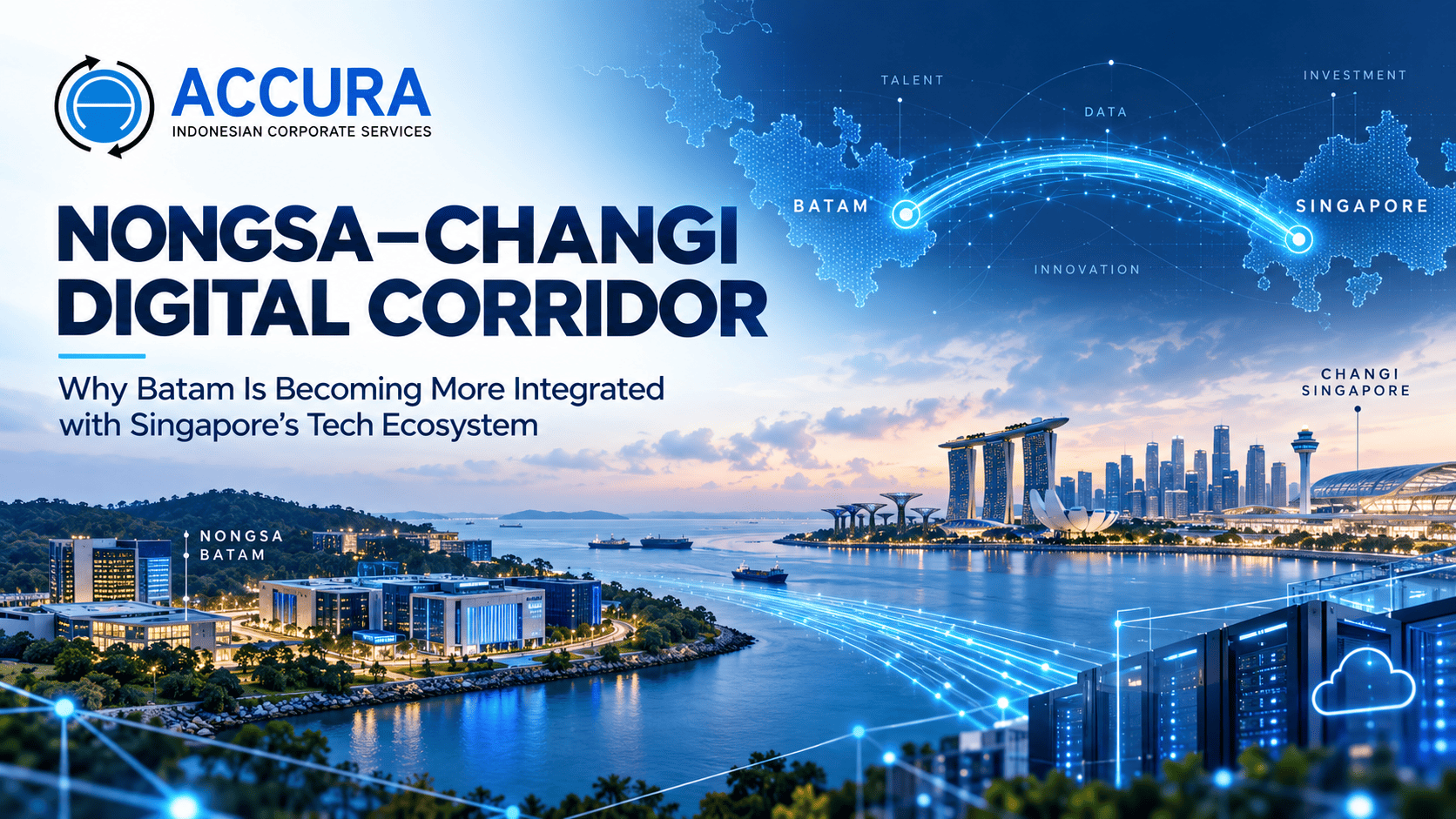
From “Digital Bridge” to Physical Digital Infrastructure
The idea of linking Batam more closely with Singapore’s technology ecosystem is not new.
When Nongsa Digital Park was launched in 2018, Singapore’s Ministry of Foreign Affairs described the project as a potential “digital bridge” connecting Singapore with Batam and other fast-growing digital communities across Indonesia.
That concept has since moved from vision to infrastructure.
On 20 July 2026, Indonesia and Singapore marked the landing of the Nongsa–Changi Cable (NCC) at Nongsa Digital Park in Batam. Indonesia’s Coordinating Ministry for Economic Affairs described the project as part of a new digital corridor strengthening connectivity, trust and economic partnership between the two countries.
Singapore’s Deputy Prime Minister and Minister for Trade and Industry Gan Kim Yong also described the cable as evidence of a deepening bilateral partnership and linked it to broader plans to develop the Batam-Bintan-Karimun (BBK) region as a digital hub.
In that sense, the “Nongsa–Changi Digital Corridor” is best understood not as a separate legal or administrative zone, but as an emerging cross-border digital ecosystem built around infrastructure, investment, technology companies and talent.
1. The Nongsa–Changi Cable Changes the Connectivity Equation
The most important new infrastructure development is the Nongsa–Changi Cable itself.
Telin describes NCC as the shortest and most direct subsea connectivity route between Nongsa Digital Park in Batam and Singapore’s data-centre ecosystem. The system uses 24 fibre pairs and is designed for hyperscalers, AI workloads, cloud platforms and high-density data-centre traffic.
Singapore’s Ministry of Trade and Industry has stated that NCC is expected to provide:
-
More than 1.6 petabits per second of additional capacity
-
Latency below two milliseconds between Batam and Singapore
-
High-capacity infrastructure for AI, cloud services and data-centre connectivity
That is significant because modern digital infrastructure is increasingly sensitive not only to capacity, but also to latency, network diversity and proximity between computing locations.
Instead of treating Batam and Singapore as completely separate digital markets, companies may increasingly be able to design infrastructure architectures that use both locations.
Singapore can continue providing international connectivity, corporate headquarters, financial infrastructure and access to global customers, while Batam offers space for large-scale digital infrastructure and access to Indonesia’s domestic economy.
The result is increasingly complementary rather than purely competitive.
NCC Project Status
The cable successfully landed in Batam in July 2026. Telin had targeted full Ready for Service status by the end of September 2026.
As of 2 October 2026, Telin lists NCC as part of its submarine cable portfolio, although the primary sources reviewed for this article did not include a separate dated announcement explicitly confirming commercial RFS following the September target.
For investors assessing network availability, commercial service dates and available capacity should therefore still be confirmed directly with the relevant infrastructure providers.
2. Batam Is No Longer Only Hosting Data Centres—It Has a Live Cloud Region
One of the strongest signals that Batam is becoming part of Southeast Asia's wider technology infrastructure is Oracle.
Oracle officially launched its Indonesia North (Batam) Oracle Cloud Infrastructure region on 15 May 2025, with region identifier ap-batam-1.
Oracle’s current global infrastructure information continues to list the Indonesia North (Batam) region as live.
This changes the discussion around Batam.
The city is no longer simply preparing for future data-centre demand. Production-grade global cloud infrastructure is already present.
Together with new subsea connectivity, this helps create conditions for more sophisticated digital workloads, including:
-
cloud applications;
-
enterprise infrastructure;
-
AI workloads;
-
disaster recovery;
-
content delivery;
-
data storage;
-
cross-border digital services; and
-
high-performance computing.
The presence of cloud infrastructure also makes Batam more relevant to companies whose primary operations may remain in Singapore but which require additional infrastructure capacity in the region.
3. Digital Investment Is Becoming a Material Part of Batam’s Economy
The development is also visible in investment figures.
According to BP Batam, Batam recorded approximately Rp8.557 trillion in digital-sector investment during 2025, making digital investment one of the city's largest investment segments.
Meanwhile, total investment momentum continued into 2026.
During Q1 2026, Batam recorded approximately Rp17.4 trillion in investment, more than doubling compared with the same period in 2025. Foreign investment accounted for approximately Rp8.8 trillion.
Most importantly for the Batam–Singapore relationship, Singapore was the largest foreign investment contributor, recording approximately Rp4.82 trillion in Q1 2026.
That position continued into the following quarter. BP Batam reported Singapore as the most dominant foreign investor in Batam during Q2 2026, ahead of South Korea, China, Hong Kong and Malaysia.
This means the digital corridor is developing on top of an already deep commercial relationship.
Singapore is not simply a neighbouring technology hub—it is already one of the most important sources of capital for Batam.
4. Data-Centre Development Is Driving New Power Infrastructure
Data connectivity alone does not create a successful data-centre cluster.
Data centres require large and increasingly predictable supplies of electricity.
Batam is therefore beginning to expand utility infrastructure alongside digital infrastructure.
In July 2026, PLN Batam and PT Altiva Identity Datacenter signed a power purchase agreement for 2 × 345 MVA, supporting the planned development of a data-centre complex in Nongsa with capacity of up to approximately 700 MVA.
Power delivery is planned to begin gradually from 2027.
Another large AI data-centre project is being developed by PT Equator Gate System Batam, backed by Range Intelligent Computing Technology. BP Batam has cited a planned investment of approximately US$5 billion, or around Rp88 trillion, for the high-density AI data-centre development in Nongsa.
Not every announced project will necessarily be delivered at its full proposed scale or on its initial timetable. Nevertheless, the associated power agreements indicate that utilities and infrastructure planning are beginning to respond to large-scale digital demand.
That is important for suppliers as well.
Growth in data-centre capacity creates potential demand extending far beyond server hardware, including electrical systems, cooling, backup generation, UPS systems, fire protection, security, construction, engineering, network equipment and facilities-management services.
5. Water Infrastructure Is Now Part of the Digital-Investment Conversation
The rapid expansion of data centres is also forcing Batam to address another infrastructure constraint: water.
In September 2026, the Batam government said data-centre developments should increasingly use independent water supplies based on seawater reverse osmosis (SWRO) rather than relying heavily on freshwater reservoirs serving households.
Authorities said initial SWRO production capacity could reach approximately 750 litres per second, eventually increasing toward 1,000 litres per second, with development planned for Nongsa and Kabil.
This is significant for investors because the competitiveness of a digital hub is ultimately determined by more than land and connectivity.
Power availability, water, cooling, network redundancy, environmental requirements and infrastructure resilience will increasingly influence where projects can actually be executed.
For companies considering Batam, utility strategy should therefore be evaluated early in the investment process rather than after the site has been selected.
6. Singapore and Indonesia Are Building Institutional Links Around the Digital Economy
Physical infrastructure is only one layer of integration.
The two countries are also strengthening institutional cooperation.
At the July 2026 Nongsa–Changi Cable ceremony, Singapore stated that both countries had agreed to undertake a joint study to identify opportunities and develop concrete recommendations for the technology sector in Batam, Bintan and Karimun.
There is also an existing Singapore–Indonesia Tech Programme, designed to allow young technology professionals from both countries to undertake cross-border work placements and help companies access talent across the two markets. The programme originates from an agreement signed during the 2023 Singapore–Indonesia Leaders’ Retreat.
Nongsa already has a track record in this area.
Singapore’s Ministry of Trade and Industry reported in 2023 that around 1,000 technology professionals at Nongsa Digital Park were servicing approximately 250 Singapore-based companies.
Singapore's Economic Development Board has subsequently highlighted Nongsa's development as a digital innovation cluster involving startups, technology training and cross-border collaboration.
The emerging corridor is therefore linking four things simultaneously:
capital, infrastructure, companies and talent.
That combination matters more than any single cable or data-centre project.
7. Batam Could Become a Complementary Infrastructure Location to Singapore
Singapore remains one of Asia's leading technology, cloud and connectivity centres.
Batam is unlikely to replace that ecosystem—and it does not need to.
Its opportunity lies in becoming increasingly integrated with it.
Singapore offers international business connectivity, financial services, global corporate networks and an established technology ecosystem.
Batam offers geographical proximity, expanding industrial and data-centre space, direct access to Indonesia, Special Economic Zone development in Nongsa and a rapidly expanding digital infrastructure base.
Nongsa Digital Park itself is located only a short ferry journey from Singapore, making physical movement between the two locations relatively practical alongside increasingly direct digital connectivity.
For businesses, this creates the possibility of operating across both markets instead of making a simple Singapore-versus-Batam location decision.
The more relevant question may become:
Which functions belong in Singapore, which belong in Batam, and how should the two locations be connected?
What Does the Nongsa–Changi Digital Corridor Mean for Foreign Companies?
The opportunity extends beyond data-centre developers.
As investment expands, opportunities may emerge for:
Data-centre technology suppliers providing cooling systems, power distribution, UPS, electrical equipment, monitoring systems and network infrastructure.
Engineering and construction firms supporting specialised data-centre facilities and supporting utilities.
Cloud and digital-service providers looking for infrastructure close to Singapore while expanding their presence in Indonesia.
Cybersecurity and network companies supporting increasingly complex cross-border digital infrastructure.
AI infrastructure companies requiring high-density computing and low-latency connectivity.
Professional and business-service providers supporting new investors entering Batam.
However, proximity to Singapore should not be mistaken for regulatory equivalence.
Batam remains within Indonesia's legal, licensing, employment, immigration and operational environment. Foreign companies planning to establish operations, supply equipment, employ personnel or provide services in Indonesia still need an appropriate Indonesian market-entry structure.
The Bigger Picture: Batam Is Moving from Industrial Satellite to Digital Gateway
For decades, Batam's relationship with Singapore was defined largely by manufacturing, logistics, shipyards and industrial supply chains.
Those sectors remain important.
But the relationship is now expanding into a new layer: digital infrastructure.
The Nongsa–Changi Cable provides direct high-capacity connectivity. Oracle has established a live Batam cloud region. Large-scale data-centre projects are expanding. Power and water infrastructure are being developed around future digital demand. Singapore remains Batam's leading foreign investor, while both governments are strengthening technology cooperation.
Taken together, these developments suggest that Batam is becoming increasingly embedded in Singapore's wider technology ecosystem.
For investors, the opportunity is therefore no longer simply:
“Why invest in Batam instead of Singapore?”
A more relevant strategic question is becoming:
“How can Batam and Singapore be used together as part of one regional operating strategy?”
And as the Nongsa–Changi digital corridor develops, companies that understand how to structure that cross-border presence early may be better positioned to capture the next phase of digital growth in Indonesia and Southeast Asia.
Planning to Enter Batam’s Growing Digital Economy?
Batam's digital-infrastructure expansion is creating opportunities for technology companies, data-centre suppliers, engineering companies, cloud businesses and international service providers—but entering the Indonesian market requires the right structure from the beginning.
ACCURA helps international companies navigate market entry, business establishment, licensing, local operational requirements and regulatory coordination in Indonesia.
If your company is evaluating opportunities connected to Nongsa Digital Park, data centres, AI infrastructure or the broader Batam–Singapore digital ecosystem, speak with ACCURA before establishing your local operations.
Enter Indonesia with the right structure. Build locally. Stay connected globally.
Visit accura.co.id to discuss your Indonesia market-entry strategy.
Key Sources & References
Coordinating Ministry for Economic Affairs of Indonesia — 20 July 2026: Official release on the Nongsa–Changi Cable landing and the development of the Indonesia–Singapore digital corridor. Read the official release
Singapore Ministry of Trade and Industry — 20 July 2026: Speech by DPM Gan Kim Yong covering NCC capacity, sub-2 ms latency, BBK digital-hub cooperation and the bilateral technology-sector study. Singapore MTI source
Telin: Current NCC infrastructure profile confirming 24 fibre pairs and direct Nongsa–Singapore data-centre connectivity. Telin cable systems
Oracle Cloud Infrastructure — updated through 2026: Official confirmation that Indonesia North (Batam) is a live Oracle Cloud region. Oracle Batam Region
BP Batam — 23 April 2026: Q1 2026 investment data, including Rp17.4 trillion total investment and Rp4.82 trillion from Singapore. BP Batam investment data
BP Batam — 2026 Digital Investment Review: Digital-sector investment in Batam reached approximately Rp8.557 trillion during 2025. BP Batam digital-sector data
PLN Batam — 28 July 2026: 2 × 345 MVA electricity agreement supporting Altiva's planned Nongsa data-centre development. PLN Batam source
Singapore Ministry of Trade and Industry — Tech Programme: Bilateral technology-talent mobility programme between Indonesia and Singapore. Singapore–Indonesia Tech Programme