
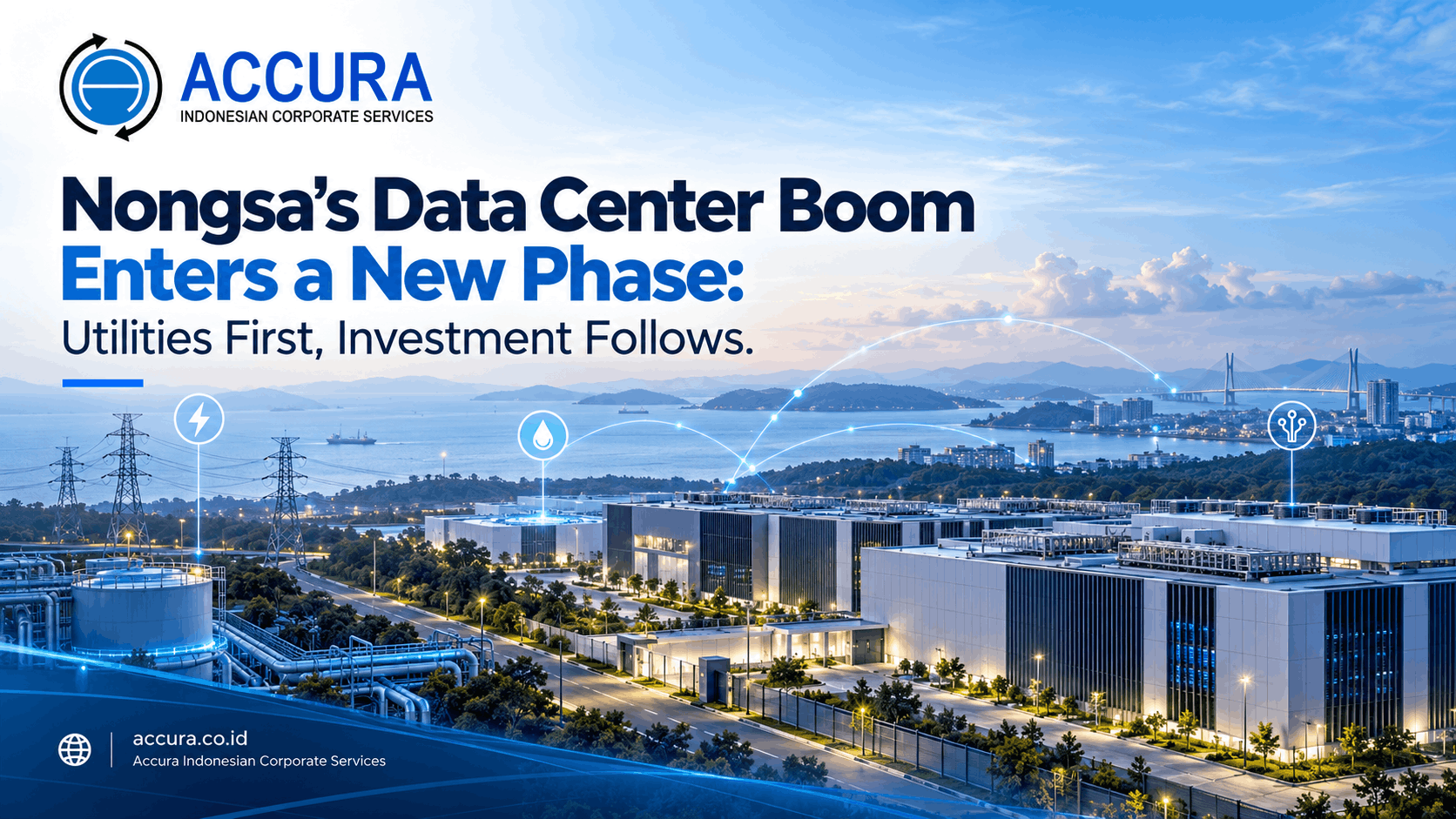
Nongsa Is Moving Beyond the “Investment Attraction” Phase
Over the past several years, Nongsa has developed from an emerging digital zone into one of the most closely watched data center locations in Indonesia.
Its appeal is relatively easy to understand: Batam sits next to Singapore, Nongsa has direct international digital connectivity, and its Special Economic Zone status was specifically designed to support digital and technology-based activities.
But in 2026, the scale of announced projects began to change the investment equation.
By mid-2026, BP Batam data cited by ANTARA indicated that data center investment in Batam had already exceeded Rp120 trillion, reflecting the rapid expansion of the sector.
More importantly, the latest BP Batam mapping released on 26 September 2026 shows that existing capacity, committed projects and the wider data center pipeline across Batam have reached approximately 1.47 GW of IT capacity.
That number changes the conversation.
Batam no longer needs to prove that global investors are interested in data centers.
It needs to prove that the infrastructure supporting those investments can scale at the same pace.
Why Power Has Become the Next Investment Gate
Data centers are fundamentally infrastructure-intensive assets.
Location, tax incentives and available land matter, but a hyperscale or AI-focused facility cannot operate without large amounts of reliable electricity delivered continuously and at commercially viable rates.
BP Batam's September 2026 assessment highlights just how significant the coming demand could become.
PLN Batam projects the Batam electricity system's peak load to increase from around 841 MW in 2026 to 2,540 MW by 2035. To prepare for that growth, available supply capacity is planned to rise to approximately 3,691 MW. BP Batam also expects 2029 to become an important threshold, with data center electricity requirements beginning to account for more than half of Batam's peak electricity demand.
This is why the investment narrative is changing from:
“Secure the investor first, prepare the infrastructure later.”
to:
“Prepare the infrastructure so the investment can operate reliably.”
BP Batam describes the new approach as “Utility First, Investment Follows.”
Its five stated priorities include competitive electricity tariffs, reliable energy supply, accelerated infrastructure development, water resilience, and stronger integration between investment commitments and utility readiness.
For investors, this is an important signal.
Future data center projects in Batam will increasingly need to evaluate electricity availability not as a post-investment operational issue, but as part of the site's investment feasibility from the beginning.
Nongsa Projects Already Show How Large the Energy Requirement Is
Individual developments in Nongsa demonstrate the scale of this transition.
In July 2026, PLN Batam and PT Altiva Identity Datacenter signed a Power Purchase Agreement covering 2 × 345 MVA.
The electricity supply is intended to support Altiva's phased data center development in Nongsa, which is planned as part of a data center complex with capacity of up to 700 MVA. Electricity delivery under the agreement is scheduled to begin gradually from 2027.
Another major example is Equator Gate System Batam (EGS).
PLN Batam announced in May 2026 that it had signed a power supply agreement to support the EGS AI Data Center in Nongsa. According to the company information published by PLN Batam, the proposed project carries an investment value of up to USD5 billion, or approximately Rp88 trillion, across a 30-hectare development intended for AI processing, machine learning and cloud computing infrastructure.
These projects show why electricity planning has become inseparable from investment planning.
A large data center does not merely become another electricity customer.
Its load can materially influence how generation, substations, transmission and distribution infrastructure must be developed across the wider Batam system.
Water Is Becoming Just as Strategic as Electricity
Electricity is only one side of the utility challenge.
Cooling systems can also create significant water requirements depending on the technology used by each data center.
That has become particularly relevant for Batam, where reservoirs remain an essential source of water for households and public needs.
On 24 September 2026, BP Batam announced that data center developments, particularly in Nongsa and Kabil, are being encouraged to develop independent Sea Water Reverse Osmosis (SWRO) infrastructure rather than relying solely on reservoir water used by the public.
The Batam Government subsequently stated that the city is targeting approximately 750 litres per second of additional SWRO production capacity in the initial stage over the next two to three years, potentially increasing toward approximately 1,000 litres per second, with development planned around the Nongsa SEZ and Kabil industrial area.
This is a significant policy direction.
It means water security is increasingly becoming part of investment infrastructure rather than simply a municipal service investors can assume will automatically be available.
BP Batam has also indicated that excess SWRO capacity could potentially support public water supply if production, water quality and distribution infrastructure allow it.
The broader principle is becoming clear:
new industrial demand should increasingly be accompanied by new utility capacity.
Connectivity Still Gives Nongsa a Strategic Advantage
While electricity and water have become the immediate bottlenecks to watch, Nongsa continues to strengthen another critical element of the data center equation: international connectivity.
In July 2026, Indonesia officially marked the landing of the Nongsa–Changi submarine cable system, further strengthening the digital corridor between Batam and Singapore.
The Coordinating Ministry for Economic Affairs highlighted Batam's growing role as Indonesia's second digital gateway after Jakarta, supported by its strategic location, international connectivity and expanding energy infrastructure.
The same government statement highlighted major developments including BW Digital's NDP1 facility at Nongsa Digital Park and other hyperscale projects being developed across Batam.
The implication is important.
Nongsa's next competitive advantage may not come simply from having nearby submarine cables.
It could come from combining international connectivity + secured power + resilient water infrastructure + investment facilitation in one ecosystem.
That combination is far harder for competing locations to replicate than land incentives alone.
“Utility First” Changes How Foreign Investors Should Assess Batam
For companies evaluating a data center, AI infrastructure project or digital infrastructure investment in Batam, conventional location due diligence is no longer enough.
Before committing capital, investors should increasingly examine:
-
Power availability and connection timeline: What capacity is actually available at the intended site, and when can it be delivered?
-
Power infrastructure responsibility: Will additional substations, distribution networks or other supporting infrastructure be required?
-
Water and cooling strategy: Will the facility rely on SWRO, water recycling, air cooling or another cooling architecture?
-
Digital connectivity and route diversity: Which international cable routes and landing points will serve the facility, and how resilient are those connections?
-
Licensing and site readiness: Does the project's legal entity, land arrangement, environmental approval, OSS licensing and construction schedule align with the utility development timeline?
-
Sustainability requirements: Can the project's future power and water strategy meet internal ESG targets and customers' sustainability expectations?
These issues should ideally be assessed before a final investment decision—not after construction has begun.
The Shift Also Creates a New B2B Opportunity Layer
The data center story in Nongsa is therefore not limited to data center operators themselves.
A utility-first development model creates opportunities throughout the supporting supply chain.
Demand could expand for high-voltage electrical systems, substations, transformers, backup generation and energy storage; cooling and HVAC technology; SWRO and industrial water treatment; water recycling systems; fiber-optic infrastructure; engineering, procurement and construction services; monitoring systems; cybersecurity; fire protection; data center testing and commissioning; environmental consultancy; and specialized maintenance services.
For foreign suppliers, however, market demand alone does not automatically translate into market access.
Companies still need to determine how they will operate commercially in Indonesia, whether through a local company, distributor, project partner, representative structure or another legally appropriate model.
They must also assess product import requirements, sector licensing, local commercial arrangements, taxation and any project-specific regulatory obligations before supplying equipment or services.
This is where early market-entry planning becomes particularly important.
Nongsa’s Next Competition Is About Certainty
For several years, Nongsa's investment proposition was built around three powerful advantages: proximity to Singapore, available development space and strong international connectivity.
Those advantages remain.
But the next phase will be decided by something different:
certainty.
Can electricity be delivered on schedule?
Can water requirements be met without placing additional pressure on residential supply?
Can supporting infrastructure keep pace with hyperscale demand?
Can investors move from licensing to construction and operation without utility timelines becoming the critical path?
BP Batam's “Utility First, Investment Follows” direction shows that authorities increasingly recognize these questions.
For Nongsa, that may be a positive sign.
The market is moving beyond the stage where investment announcements alone define success. The real test is now whether infrastructure can convert those commitments into operating facilities.
And for investors entering Batam, utility due diligence may soon become just as important as legal, tax and regulatory due diligence.
Planning a Data Center or Digital Infrastructure Investment in Batam?
Large infrastructure investments require more than selecting a site.
Foreign investors must align company establishment, investment licensing, land arrangements, environmental requirements, utility planning, tax considerations and operational compliance before a project becomes commercially ready.
Accura can help foreign investors assess their market-entry structure and navigate the regulatory and operational requirements for establishing and expanding a business in Batam and Indonesia.
From initial feasibility and company setup to licensing and ongoing compliance, early preparation can help identify regulatory gaps before they affect the investment timeline.
Planning an investment in Nongsa, Batam, or elsewhere in Indonesia?
Visit Accura at www.accura.co.id to discuss your market-entry and compliance requirements.
Sources
-
BP Batam — 26 September 2026: BP Batam dan PLN Siapkan Strategi Energi Hadapi Lonjakan Investasi Data Center — source for the 1.47 GW data center pipeline, 2026–2035 electricity projections and “Utility First, Investment Follows” priorities. BP Batam source
-
BP Batam — 24 September 2026: BP Batam Dorong Data Center Bangun Infrastruktur SWRO — source for the SWRO policy direction for Nongsa and Kabil. BP Batam SWRO source
-
Pemerintah Kota Batam — 25 September 2026: SWRO capacity planning of approximately 750 litres/second initially and around 1,000 litres/second as development expands.
-
PLN Batam — 28 July 2026: Altiva Identity Datacenter PJBTL of 2 × 345 MVA for the Nongsa development. PLN Batam – Altiva
-
PLN Batam — 25 May 2026: EGS AI Data Center investment and electricity cooperation in Nongsa. PLN Batam – EGS
-
Coordinating Ministry for Economic Affairs — 20 July 2026: Nongsa–Changi submarine cable and Batam digital infrastructure development.
-
National Council for Special Economic Zones: KEK Nongsa legal basis, infrastructure and permitted digital-economy activities.
-
ANTARA — 24 July 2026: BP Batam investment and utility analysis, including the development of the “Utility First, Investment Follows” concept.
Data and project pipelines can change as individual investments move from planning and negotiation into construction and operation. Figures above reflect the latest publicly available information identified as of 28 September 2026.