
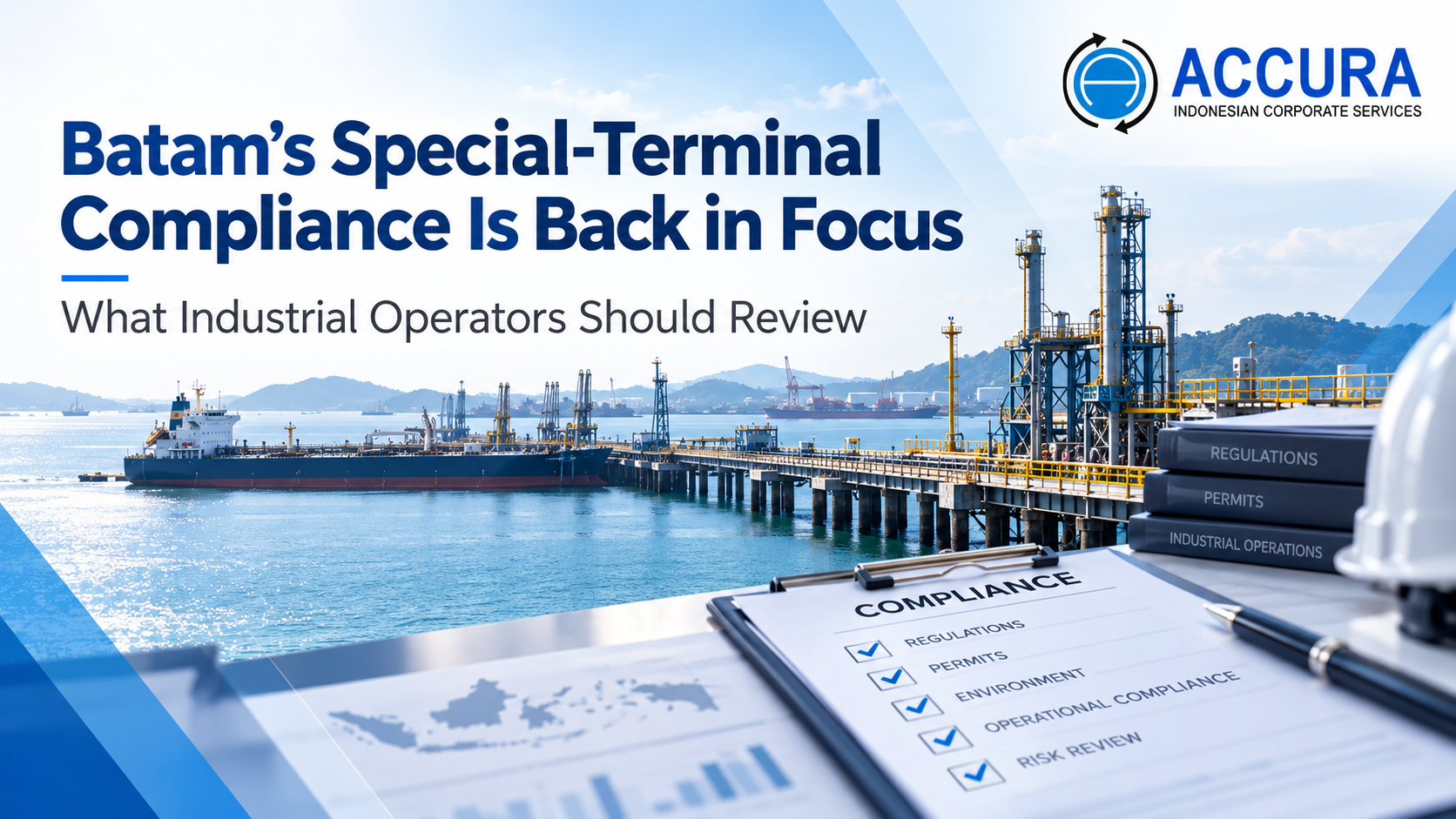
Why Special-Terminal Compliance Is Back in Focus in Batam
On 21 September 2026, BP Batam announced the settlement of approximately Rp18.82 billion in PNBP related to water-area rental for Terminal Khusus for the 2021–2025 period.
According to BP Batam, 111 out of 135 Tersus holders covered by the handling process had completed their obligations by September 2026. The process involved cooperation between BP Batam, the Batam District Prosecutor’s Office, business associations and terminal operators.
This development matters beyond the payment itself.
For industrial operators, it is a practical indication that Tersus compliance is not limited to obtaining an initial construction or operating approval. Authorities are also paying attention to how waterfront areas are used, whether financial obligations have been fulfilled and whether terminal operations remain consistent with their approved purpose.
That makes 2026 a sensible time for companies to conduct a fresh compliance review.
First: Understand What a Terminal Khusus Is
Under Minister of Transportation Regulation PM 52/2021, a Terminal Khusus is a terminal located outside the working and interest areas of a public port and connected to the nearest port, established to serve the operator's own interests in accordance with its main business activity.
The regulation allows Tersus facilities to support sectors including manufacturing, mining and quarrying, electricity and gas, water and waste management, construction, wholesale trade and other activities that require dedicated jetty facilities.
Importantly, a Tersus is not simply a private commercial port.
Its legal justification is linked to the operator's underlying business activity. PM 52/2021 states that a special terminal may be established where the nearest port cannot accommodate the main business activity, or where a dedicated terminal is considered more effective and efficient from economic and technical-operational perspectives while supporting navigation safety and security.
That connection between the terminal and the company's main business should therefore be one of the first things operators review.
What Should Industrial Operators Review?
| Compliance Area | What Companies Should Check |
|---|---|
| 1. Main business and terminal purpose | Confirm that the Tersus still supports the company's registered main business activity and that changes in KBLI, production activities or corporate structure have not created a mismatch. |
| 2. Operating approval validity | Check the validity period, extension status and details stated in the Tersus operating approval. Under PM 52/2021, an operating permit may be granted for up to five years and may be extended. |
| 3. Changes in company or licence data | Where the underlying main business is transferred, PM 52/2021 requires the transfer to be reported to the Director General within three months, followed by adjustment of the operating licence. Changes to other licence data can also require adjustment. |
| 4. Actual cargo and terminal use | Confirm that cargo handled through the Tersus consists of raw materials, production output or production-support equipment connected to the operator's own business. Supporting cargo or passenger documentation should also match actual activity. |
| 5. Use by third parties | A Tersus should not automatically be treated as a public terminal. Use for public interests outside its normal permitted scope requires separate approval under PM 52/2021. |
| 6. Water-area arrangements and PNBP | Review agreements covering the water area used by the terminal, historical billing and payment records, particularly following BP Batam's 2026 settlement initiative covering 2021–2025 obligations. |
| 7. Technical configuration | Check whether the approved coordinates, berth configuration, access channel, terminal basin, vessel size and navigation facilities remain consistent with actual conditions. BP Batam's permitting requirements include technical studies, geographical coordinates, navigation considerations and technical berth plans. |
| 8. Environmental approvals | Ensure the environmental approval and supporting environmental documents still cover the terminal's current physical layout, cargo types and operational activities. |
| 9. Maritime safety | PM 52/2021 places operational supervision on the relevant port authority and safety functions on the nearest harbourmaster, making operational safety compliance separate from commercial or investment licensing. |
| 10. International trade status | A Tersus handling international-trade activities should verify whether the necessary designation for foreign-trade operations is in place rather than assuming a normal Tersus operating approval is sufficient. PM 52/2021 separately regulates Tersus facilities opened for foreign trade. |
Do Not Treat the Operating Permit as a Standalone Document
One of the most important compliance mistakes is reviewing the Tersus operating licence in isolation.
In practice, several documents may need to remain consistent with one another: the company's NIB and business activities, Tersus construction and operating approvals, technical drawings and coordinates, environmental approvals, land or waterfront rights, water-use arrangements, cargo documentation and actual terminal operations.
For example, a company may originally have developed a terminal for one manufacturing activity but later expanded into another product line, changed its KBLI, added a subsidiary or changed the types of materials moving through the jetty.
Even if the physical terminal has not changed, the regulatory position may have.
PM 52/2021 specifically requires licence adjustments following certain changes to the underlying business or licence data.
The Batam Regulatory Structure Has Also Changed
Companies should also make sure their compliance review uses the current regulatory framework, rather than relying on an old licensing checklist.
At the national level, PP 28/2025 replaced PP 5/2021 as Indonesia's principal risk-based business licensing regulation. Meanwhile, PP 25/2025 amended PP 41/2021 governing Free Trade Zones and Free Ports, including Batam.
BP Batam states that following the regulatory changes, business licensing and supporting business licensing within the Batam FTZ have increasingly been consolidated under BP Batam's authority.
There has also been a more recent local port regulation.
BP Batam currently lists Peraturan Kepala BP Batam No. 4 Tahun 2026 on Port Administration in the Batam Free Trade and Free Port Zone as being in force. Its official regulatory register marks earlier port-tariff regulations including Perka BP Batam No. 4/2023 and No. 34/2021 as no longer effective.
That distinction is important.
Operators reviewing old agreements, invoices or internal compliance files should verify them against the regulation currently applicable to their activity rather than automatically relying on previous tariff or administrative rules.
Why the PNBP Settlement Matters
The September 2026 settlement is particularly relevant because it involved obligations accumulated over several years.
BP Batam reported that the Rp18.82 billion collected covered the 2021–2025 period, showing that historical compliance can still become a current issue.
This means an internal review should not focus only on whether invoices for 2026 have been paid.
Companies may also need to check whether earlier periods contain missing agreements, unpaid or disputed invoices, differences in the area used to calculate water utilisation, incomplete records following regulatory transfers, or inconsistencies between permits and actual waterfront use.
For companies considering an acquisition, joint venture, factory purchase or restructuring involving waterfront industrial property, these historical obligations should also form part of regulatory due diligence.
Operational Scope Is Another Key Risk Area
PM 52/2021 limits normal Tersus operations primarily to activities serving the operator's own business, including the movement of raw materials, production output and production equipment.
Using a private terminal for unrelated third-party cargo should therefore not be treated simply as an additional revenue opportunity.
Where a Tersus is temporarily required to serve the public interest, PM 52/2021 provides a separate approval mechanism.
Companies operating industrial estates, shipyards or manufacturing clusters should pay particular attention to this distinction, especially when multiple related and unrelated companies share waterfront infrastructure.
The correct regulatory treatment may depend on the relationship between the cargo owner, terminal operator, parent company, subsidiaries and their respective main business activities.
Non-Compliance Can Affect the Licence Itself
The regulatory consequences are not limited to additional paperwork.
Under PM 52/2021, violations associated with Tersus operations can progress through written warnings, licence suspension and ultimately licence revocation if corrective action is not taken.
The regulation provides for three written warnings, each with a 30-working-day period, followed by a potential 30-working-day suspension before revocation where the operator still fails to correct the violation.
Operating a Tersus for public interests without the required approval is also specifically identified as a basis for potential revocation of the operating licence.
For businesses dependent on regular inbound raw materials or outbound industrial cargo, that makes Tersus compliance an operational continuity issue—not merely an administrative one.
What Should Investors Do Before Acquiring a Waterfront Industrial Site?
Foreign investors evaluating manufacturing plants, shipyards, energy projects or other waterfront businesses in Batam should include Tersus compliance in their pre-investment due diligence.
The review should answer a simple question:
Do the corporate licences, terminal approvals, physical facilities, water-area arrangements and actual logistics activities all describe the same operation?
If they do not, the company should identify the gap before a transaction, expansion or production ramp-up.
This can be particularly important where the investor is acquiring an existing Indonesian company rather than building a facility from the ground up. Historical terminal obligations may remain commercially relevant even when ownership changes.
Final Takeaway
Batam's latest Tersus development should not necessarily be read as a new rule suddenly appearing in 2026.
Instead, it shows that existing terminal, water-use and payment obligations are being actively reviewed and regularised.
For industrial operators, this creates a timely reason to reassess their compliance position.
A strong review should go beyond asking whether the company possesses a Tersus permit. It should examine whether the permit remains valid, whether operations still match the approved main business, whether corporate and licence data are aligned, whether water-area obligations are clear, whether technical and environmental approvals reflect current conditions and whether actual cargo movements remain within the permitted operational scope.
For companies whose supply chains depend on dedicated marine access, resolving these issues early can help reduce licensing uncertainty and protect operational continuity.
How Accura Can Help
Planning to acquire, expand, restructure or operate an industrial facility with a Terminal Khusus in Batam?
Accura can help businesses map the applicable licensing framework, review existing corporate and operational permits, identify regulatory gaps and coordinate the required licensing process with the relevant authorities in Batam.
Review your Tersus compliance before it becomes an operational issue.
Visit accura.co.id to discuss your Batam market-entry, licensing and regulatory requirements.
This article is intended for general business information and does not constitute legal advice.
Main Sources
-
BP Batam — 21 September 2026: Rp18.82 billion PNBP settlement for Tersus water-area obligations for 2021–2025; 111 of 135 Tersus holders had completed their obligations.
-
ANTARA — 22 September 2026: Independent reporting on the BP Batam–Kejari Tersus PNBP settlement.
-
Ministry of Transportation / JDIH — PM 52 Tahun 2021: Current regulation governing Terminal Khusus and Terminal untuk Kepentingan Sendiri.
-
BP Batam Port Regulatory Register: Perka BP Batam No. 4 Tahun 2026 is listed as currently in force; earlier port-tariff regulations are marked no longer effective.
-
PP 25 Tahun 2025 and PP 28 Tahun 2025: Updated framework for Batam FTZ administration and risk-based business licensing.
-
BP Batam PTSP: Requirements and technical documentation associated with Tersus construction/development, including technical studies, berth plans, coordinates, navigation considerations and environmental documentation.