
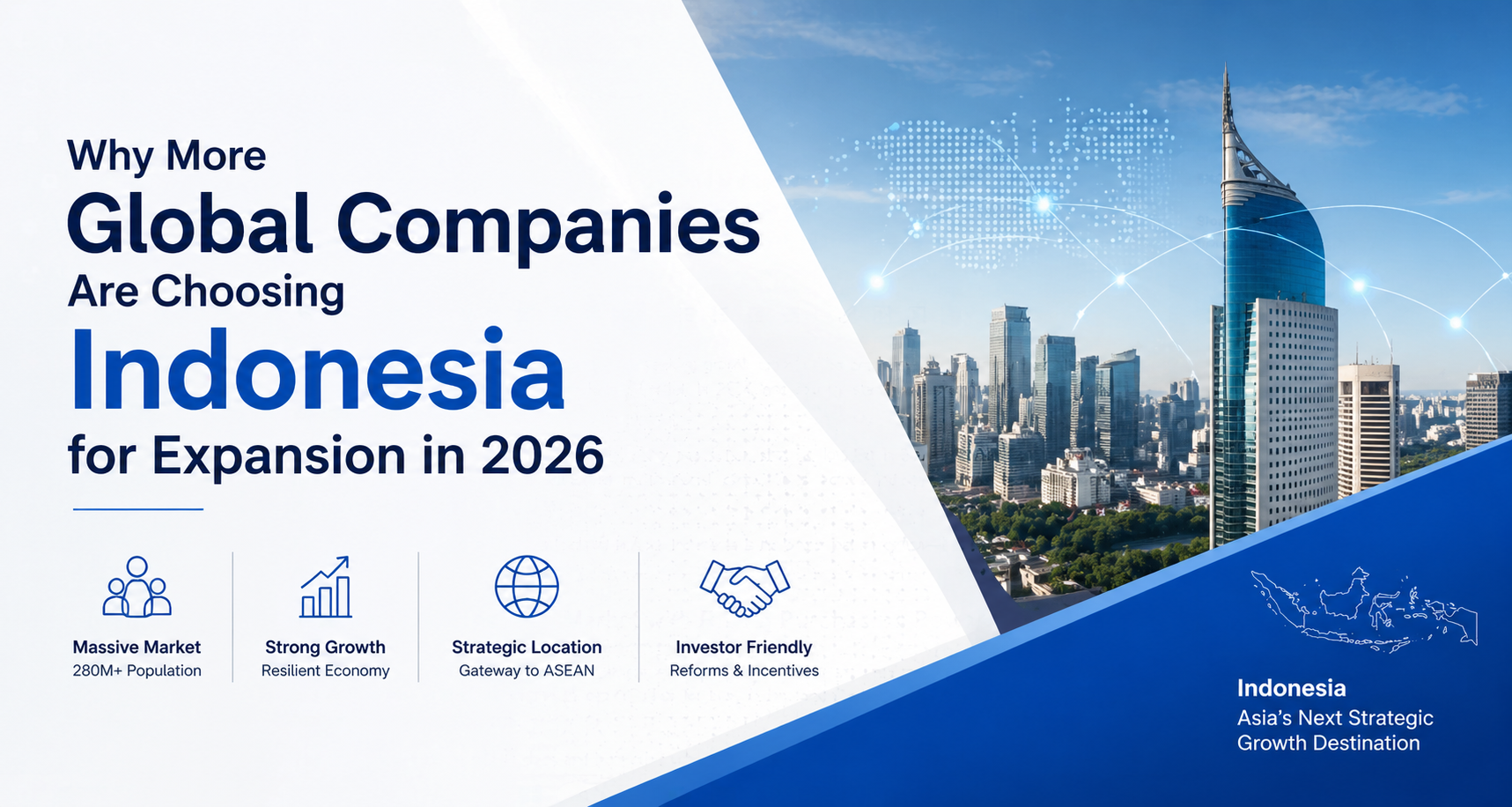
As global markets continue to evolve, companies seeking growth opportunities are increasingly turning their attention to emerging economies with strong long-term potential. In 2026, one country stands out prominently on the global expansion map: Indonesia.
With its rapidly growing economy, young digital-savvy population, strategic location in Southeast Asia, and improving investment climate, Indonesia is attracting multinational corporations across industries—from technology and manufacturing to finance and logistics.
For businesses aiming to establish a foothold in Asia, Indonesia is no longer just an option—it is becoming a strategic necessity.
1. A Massive Consumer Market with Rising Purchasing Power
Indonesia is home to more than 280 million people, making it the fourth most populous country in the world. This large and diverse market provides enormous opportunities for businesses targeting consumer goods, services, fintech, healthcare, and digital solutions.
The country’s expanding middle class and increasing urbanization are fueling demand for premium products, modern retail experiences, and innovative technologies. For global brands, Indonesia offers both scale and growth momentum.
In 2026, this consumer-driven economy continues to position itself as one of Asia’s most promising business destinations.
2. Strategic Gateway to Southeast Asia
Located at the heart of Southeast Asia, Indonesia serves as a vital gateway to regional markets. Its position along key global shipping routes strengthens its role in international trade and supply chain networks.
For companies looking to access ASEAN markets, Indonesia provides direct connectivity to neighboring economies while offering domestic demand large enough to justify localized operations.
This makes Indonesia particularly attractive for regional headquarters, distribution centers, and manufacturing hubs.
3. Government Reforms Supporting Foreign Investment
Indonesia has introduced significant regulatory reforms in recent years to improve the ease of doing business and attract foreign direct investment.
Policies aimed at simplifying licensing, reducing bureaucracy, and expanding sectors open to foreign ownership have strengthened investor confidence. The implementation of digitalized systems for permits and compliance has further streamlined business setup processes.
For global companies entering the Indonesian market in 2026, these reforms create a more accessible and business-friendly environment than ever before.
4. A Thriving Digital Economy
Indonesia’s digital economy is among the fastest-growing in the world. E-commerce, fintech, healthtech, and software services continue to expand at an accelerated pace, supported by widespread internet adoption and smartphone penetration.
This creates opportunities not only for digital-first companies but also for traditional industries undergoing digital transformation.
For technology firms, startups, and innovation-driven enterprises, Indonesia provides fertile ground for scalable growth.
5. Competitive Operational Costs
Compared to many developed markets and regional competitors, Indonesia offers cost advantages in labor, real estate, and operational expenses.
These efficiencies allow businesses to optimize budgets while maintaining high growth potential. For manufacturers, service providers, and outsourcing firms, Indonesia presents an attractive balance between affordability and market access.
As global companies seek sustainable expansion models, cost competitiveness remains a major factor driving investment decisions.
6. Emerging Business Ecosystems in Strategic Locations
Cities and industrial zones across Indonesia are becoming specialized business ecosystems.
Areas such as Batam, Jakarta, Surabaya, and Bali offer unique advantages depending on industry focus—whether manufacturing, digital business, tourism, or international trade.
For example, Batam’s proximity to Singapore and its free trade zone benefits make it a strategic choice for foreign investors seeking operational efficiency with regional connectivity.
These location-based ecosystems allow businesses to align expansion strategies with sector-specific opportunities.
Challenges to Consider
While Indonesia presents compelling advantages, successful expansion requires navigating local regulations, employment laws, tax obligations, and cultural nuances.
Partnering with experienced local advisors can help businesses ensure compliance and accelerate market entry.
Understanding the legal and operational landscape is essential for long-term success.
Final Thoughts
Indonesia’s rise as a preferred destination for global expansion in 2026 is driven by a combination of market scale, economic resilience, digital growth, and supportive reforms.
For international companies looking to strengthen their presence in Asia, Indonesia offers more than opportunity—it offers strategic advantage.
The businesses that move early and establish strong local foundations will be best positioned to capture the country’s long-term growth potential.
Call to Action
Planning to expand your business into Indonesia? Partner with experts who understand the regulatory, legal, and operational landscape to ensure a smooth and compliant market entry.