
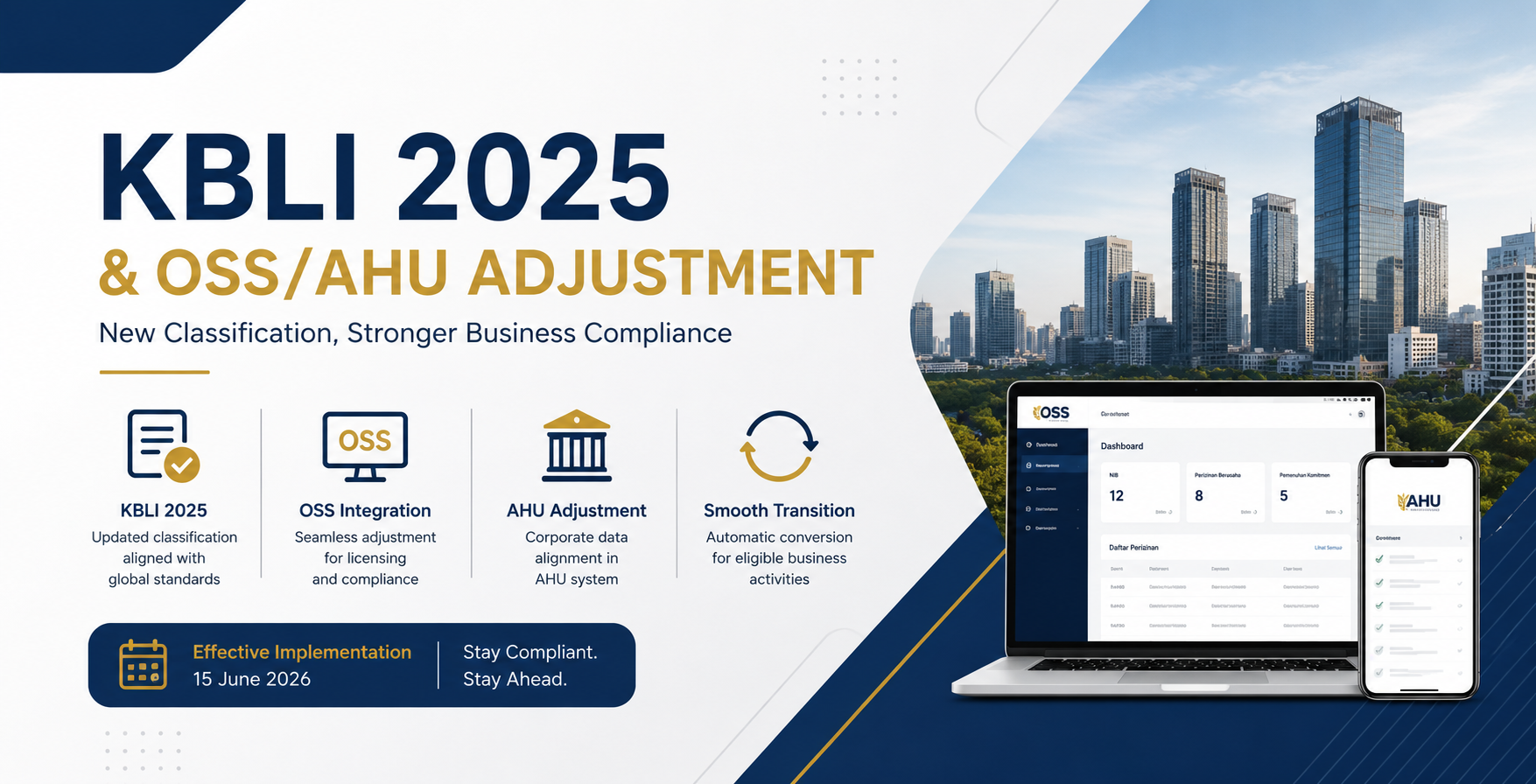
Indonesia has officially begun implementing Klasifikasi Baku Lapangan Usaha Indonesia (KBLI) 2025, marking one of the most significant updates to the country's business classification framework in recent years.
As of 15 June 2026, the Directorate General of General Legal Administration (AHU) and the Online Single Submission (OSS) system have started applying KBLI 2025 for business registration and licensing processes. The adjustment aims to align Indonesia's business classifications with emerging industries, international standards, and the government's risk-based licensing framework.
For businesses, investors, and corporate administrators, understanding how the KBLI 2025 transition affects OSS and AHU systems is essential to maintain compliance and avoid disruptions in licensing and corporate administration.
What Is KBLI 2025?
KBLI (Klasifikasi Baku Lapangan Usaha Indonesia) is Indonesia's official classification system for economic activities issued by the Central Statistics Agency (BPS).
KBLI serves as the foundation for:
- Business registration
- OSS licensing applications
- Risk classification
- Foreign investment regulations
- Tax and reporting obligations
- Sector-specific permits
KBLI 2025 was introduced through BPS Regulation No. 7 of 2025, replacing KBLI 2020 and updating classifications to reflect the rapid evolution of Indonesia's economy. The new framework is aligned with the latest international standard, ISIC Revision 5, while incorporating business activities unique to Indonesia.
Why Was KBLI Updated?
Several factors drove the introduction of KBLI 2025:
1. Emergence of New Industries
The digital economy, fintech, blockchain, renewable energy, electric vehicle ecosystems, and advanced business services have grown significantly since KBLI 2020 was issued.
KBLI 2025 introduces more detailed classifications for these sectors, providing clearer regulatory guidance and licensing pathways.
2. Alignment with Global Standards
The new classification aligns Indonesia's economic statistics and business regulations with international practices under ISIC Revision 5.
3. Improved Risk-Based Licensing
A more accurate business classification system enables OSS-RBA to determine licensing requirements and risk levels more precisely.
Key Changes in KBLI 2025
Structural Changes
| Classification Level | KBLI 2020 | KBLI 2025 |
|---|---|---|
| Categories | 21 | 22 |
| Main Groups (2-digit) | 88 | 87 |
| Groups (3-digit) | 245 | 257 |
| Subgroups (4-digit) | 567 | 519 |
| Business Activity Codes (5-digit) | 1,789 | 1,560 |
Reclassification of Business Activities
Several business sectors have been reorganized, merged, or split into more specific categories.
For example:
- Vehicle repair and maintenance activities are no longer grouped under wholesale and retail trade.
- New classifications have been introduced for crypto asset activities, blockchain development, and other digital economy sectors.
- Emerging sustainability and technology-related industries receive more specific treatment.
OSS and AHU Adjustment: What Has Changed?
The implementation of KBLI 2025 requires synchronization between multiple government systems, particularly:
- AHU Online (Ministry of Law)
- OSS-RBA (Risk-Based Online Single Submission)
- Sectoral licensing systems connected to OSS
The government has introduced a coordinated transition mechanism to ensure a smooth migration from KBLI 2020 to KBLI 2025.
Automatic Conversion Mechanism
One of the most important features of the transition is the automatic conversion process.
According to the Ministry of Law, businesses whose KBLI codes have direct equivalents in KBLI 2025 may benefit from automatic conversion within AHU and OSS systems. This minimizes administrative burdens and reduces the need for manual amendments.
The government has also prepared a conversion table linking KBLI 2020 codes to their KBLI 2025 counterparts.
Benefits of Automatic Conversion
- Faster transition process
- Reduced compliance costs
- Minimal disruption to business operations
- Better integration between AHU and OSS databases
Manual Adjustment Cases
Not all business activities qualify for automatic conversion.
Manual adjustment may be required when:
- A KBLI 2020 code is split into multiple KBLI 2025 codes
- Business activities have significantly changed classification
- The company's Articles of Association (AoA) need updating
- Additional licensing implications arise from the new classification
In such situations, companies may need to amend corporate documents and update information through AHU and OSS systems.
Timeline for Implementation
Important Dates
| Date | Milestone |
|---|---|
| 18 December 2025 | KBLI 2025 officially issued through BPS Regulation No. 7 of 2025 |
| January–June 2026 | Government system adjustments and migration preparations |
| 15 June 2026 | KBLI 2025 officially implemented in AHU and OSS |
| June 2026 onward | New registrations and amendments use KBLI 2025 |
The government has emphasized that the transition is designed to avoid unnecessary administrative burdens and does not automatically require businesses to obtain new licenses solely because of the classification update.
Impact on Existing Businesses
Existing companies should review their registered business activities to determine whether their current KBLI codes remain appropriate under the new framework.
Areas that should be reviewed include:
Articles of Association (AoA)
Ensure that business purposes and objectives remain aligned with the updated KBLI classifications.
OSS Licenses
Verify whether risk classifications or licensing requirements have changed.
Business Expansion Plans
Companies planning to add new business activities should ensure they use KBLI 2025 codes for future registrations.
Foreign Investment Compliance
For PT PMA companies, KBLI selection remains critical because it influences investment restrictions, licensing obligations, and sectoral requirements.
What Should Companies Do Now?
To ensure compliance with KBLI 2025, businesses should take the following steps:
Step 1: Review Existing KBLI Codes
Identify all KBLI codes currently registered in AHU and OSS.
Step 2: Check the Conversion Mapping
Determine whether your existing KBLI codes are automatically converted or require manual adjustments.
Step 3: Assess Licensing Implications
Review whether the updated classification affects your business risk level or permits.
Step 4: Update Corporate Documents
If necessary, amend Articles of Association and corporate registrations.
Step 5: Coordinate with Professional Advisors
Work with legal, corporate secretarial, or business consulting professionals to ensure a smooth transition.
How KBLI 2025 Supports Indonesia's Investment Climate
The implementation of KBLI 2025 is part of Indonesia's broader effort to modernize its investment and licensing ecosystem.
Key objectives include:
- Enhancing legal certainty
- Increasing licensing efficiency
- Supporting risk-based business regulation
- Improving investment competitiveness
- Accommodating emerging economic sectors
The integration of KBLI 2025 into AHU and OSS demonstrates the government's commitment to creating a more transparent and investor-friendly business environment.
Conclusion
The transition from KBLI 2020 to KBLI 2025 represents a significant milestone in Indonesia's business licensing framework. While many companies will benefit from automatic conversion mechanisms within AHU and OSS, businesses should still proactively review their classifications, licensing status, and corporate documents.
Understanding how KBLI 2025 interacts with OSS-RBA and AHU systems is crucial for maintaining compliance, avoiding administrative issues, and ensuring smooth business operations in Indonesia.
As the implementation progresses throughout 2026, businesses that prepare early will be better positioned to take advantage of Indonesia's evolving regulatory landscape.