
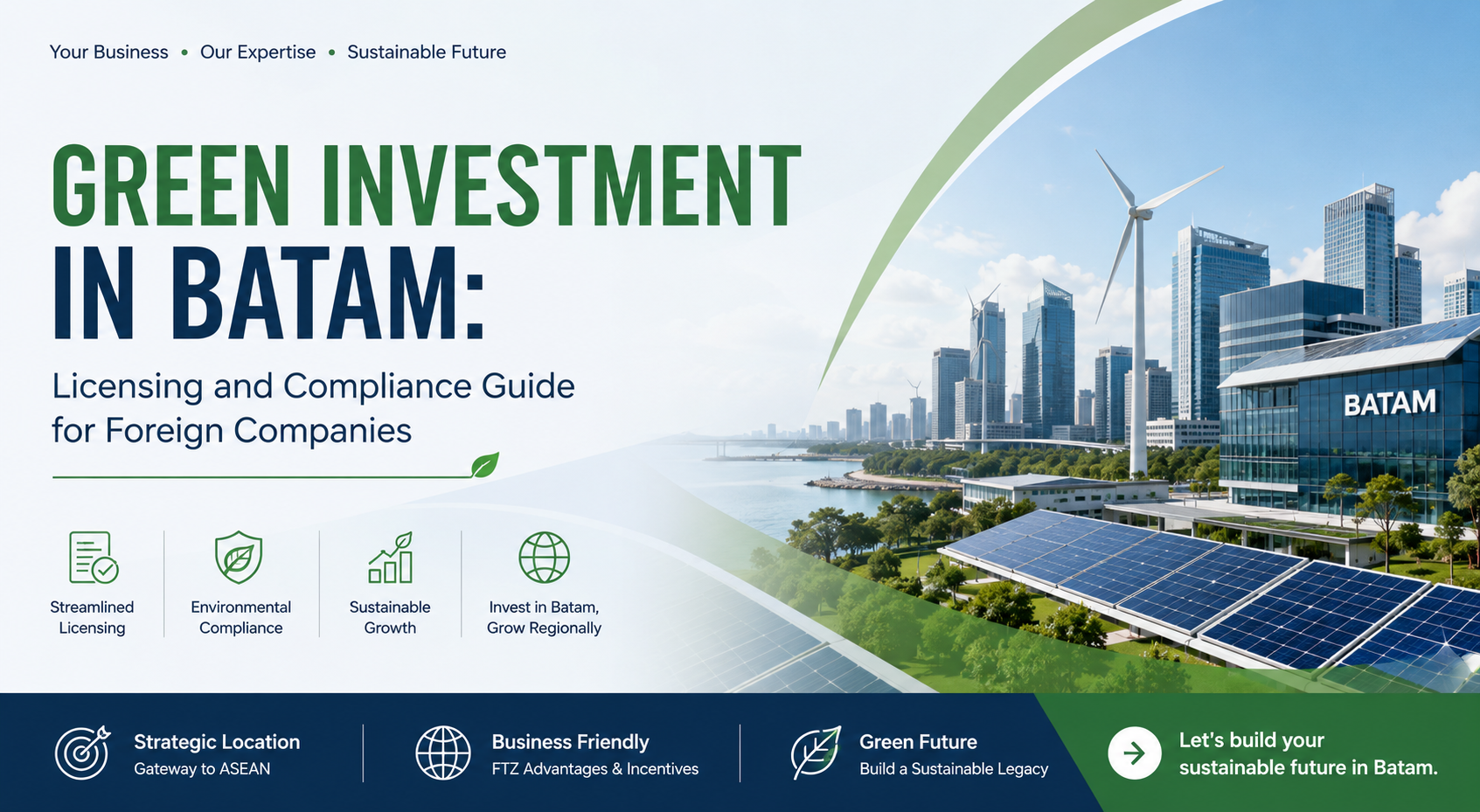
Batam is no longer viewed only as a manufacturing and logistics hub. Today, it is increasingly positioned as a gateway for sustainable investment, digital infrastructure, renewable energy, green manufacturing, and ESG-driven business expansion in Indonesia.
Located close to Singapore and Malaysia, Batam offers a strategic base for foreign companies seeking regional access, cost efficiency, and proximity to international supply chains. BP Batam describes the city as a strategic Southeast Asian location directly adjacent to Singapore and Malaysia, making it an important industrial and trade area in Indonesia.
This momentum is supported by strong investment performance. In 2025, Batam recorded Rp69.30 trillion in investment realization, exceeding its Rp60 trillion target and helping drive economic growth of 6.76%. Digital investment alone reached Rp8.557 trillion, supported by the development of Nongsa Digital Park and data center-related activities.
For foreign companies, the opportunity is clear. But so is the compliance responsibility. Green investment in Batam requires more than capital. It requires the right business structure, correct KBLI classification, OSS licensing, environmental approval, land and building compliance, sector-specific permits, tax registration, and post-licensing reporting.
Why Batam Is Attractive for Green Investment
Batam offers several advantages for foreign investors entering Indonesia’s green economy.
First, Batam’s Free Trade Zone status provides a competitive framework for import, export, logistics, and manufacturing activities. Under Indonesia’s Free Trade Zone framework, Batam is part of the Kawasan Perdagangan Bebas dan Pelabuhan Bebas, or KPBPB, which is regulated under PP 41/2021. The regulation covers institutional management, licensing services, facilities, ease of doing business, area development, and sanctions within free trade and free port zones.
Second, BP Batam highlights that companies operating in Batam’s FTZ may benefit from exemptions related to VAT, luxury goods tax, import duties, and export duties, subject to applicable FTZ rules and customs procedures.
Third, Batam is gaining relevance in digital and energy-related investment. BP Batam reported that in 2025, investment in services, digitalization, machinery, electronics, electrical equipment, electricity, gas, and water contributed significantly to Batam’s investment realization. The electricity, gas, and water sector alone recorded Rp5.80 trillion, reflecting investor interest in energy infrastructure, including renewable energy-related opportunities.
Fourth, Indonesia’s national investment trend remains substantial. In 2025, Indonesia’s total investment realization reached Rp1,931.2 trillion, with foreign direct investment contributing Rp900.9 trillion. In Q1 2026, investment realization reached Rp498.8 trillion, growing 7.2% year-on-year.
For ESG-focused investors, this creates a strong entry point for sectors such as renewable energy, solar panel supply chains, green data centers, low-carbon manufacturing, water treatment, waste management, sustainable logistics, and energy efficiency services.
What Counts as Green Investment in Batam?
Green investment in Batam may include business activities that support environmental sustainability, carbon reduction, resource efficiency, or clean technology adoption.
Common examples include:
Renewable energy projects, solar panel manufacturing, energy storage, EV infrastructure, green building materials, water treatment, wastewater management, recycling, circular economy businesses, sustainable packaging, green logistics, smart energy systems, and data centers powered by cleaner or more efficient energy solutions.
For foreign companies, the most important first step is not simply choosing a “green” label. The company must identify the correct KBLI business classification. KBLI determines the company’s business scope, foreign ownership eligibility, OSS risk level, licensing requirements, and reporting obligations.
Indonesia has updated its business classification framework through KBLI 2025. BPS states that KBLI is used to group economic activities based on similar characteristics, and KBLI 2025 was prepared to reflect increasingly diverse and detailed economic activities. BKPM has also announced the implementation of KBLI 2025 in relation to OSS and AHU systems.
Step 1: Establish the Right Foreign Investment Vehicle
Most foreign investors operating commercially in Indonesia must establish a PT PMA, or foreign investment limited liability company.
Before incorporation, investors should confirm:
The correct KBLI code, foreign ownership restrictions, minimum capital and investment requirements, business location, tax obligations, environmental obligations, sectoral licenses, and whether the activity is allowed within Batam’s FTZ framework.
Indonesia’s Positive Investment List, regulated under Presidential Regulation No. 10 of 2021 as amended by Presidential Regulation No. 49 of 2021, provides the framework for business fields open to investment. Under this framework, all commercial business fields are generally open to investment unless they are closed or reserved for the central government.
Foreign investors must also consider the latest BKPM rules. Permeninves/BKPM No. 5 of 2025 regulates procedures for risk-based business licensing, investment facilities, OSS licensing services, supervision, sanctions, and transitional provisions. It came into effect on 2 October 2025 and replaced previous BKPM regulations on OSS, licensing procedures, and supervision.
Step 2: Register Through OSS and Obtain the NIB
Indonesia uses the Online Single Submission system, commonly known as OSS, for business licensing.
Under PP 28/2025, Indonesia’s risk-based licensing system covers basic requirements, business licenses, supporting business licenses, OSS services, supervision, evaluation, policy reform, funding, problem resolution, and sanctions. The regulation came into effect on 5 June 2025 and revoked PP 5/2021.
The key license issued through OSS is the NIB, or Business Identification Number. The NIB functions as the company’s basic business identity and is required before the company can legally operate.
However, an NIB alone may not be sufficient. Depending on the KBLI and risk level, a foreign company may also need:
Standard Certification, Business License, Environmental Approval, PB UMKU, sectoral approval, customs access, land or location approval, building approval, and operational permits.
Step 3: Understand Risk-Based Licensing
Indonesia’s OSS system classifies business activities based on risk.
Low-risk activities generally require an NIB. Medium-low risk activities may require an NIB and self-declared standard certificate. Medium-high risk activities may require an NIB and verified standard certificate. High-risk activities require an NIB and a business license before commercial operations can begin.
For green investment projects, the risk level depends on the actual activity. A consulting company advising on ESG may face lighter licensing requirements than a renewable energy facility, manufacturing plant, recycling operation, wastewater treatment facility, or data center project.
This is why foreign investors should avoid choosing KBLI codes only based on broad business descriptions. The wrong KBLI may trigger licensing problems, environmental mismatches, LKPM reporting issues, and future amendment requirements.
Step 4: Secure Environmental Approval
Environmental compliance is one of the most important parts of green investment in Batam.
Indonesia regulates environmental approvals through PP 22/2021, which covers environmental approval, water quality protection, air quality protection, marine quality protection, environmental damage control, hazardous and non-hazardous waste management, environmental information systems, supervision, and administrative sanctions.
Depending on the business activity, scale, location, and environmental impact, a company may need one of the following:
AMDAL, UKL-UPL, or SPPL.
Permen LHK No. 4/2021 provides the list of business activities that require AMDAL, UKL-UPL, or SPPL.
For foreign companies entering Batam’s green economy, environmental approval should not be treated as a final administrative step. It should be integrated early into site selection, facility design, operational planning, waste management, water use, emissions control, and ESG reporting.
This is especially important for projects involving manufacturing, renewable energy infrastructure, waste processing, water treatment, chemical handling, batteries, solar components, logistics facilities, and data center operations.
Step 5: Check Land, Building, and Location Compliance
Green investment projects often require physical facilities, land use, utilities, and infrastructure access.
Foreign companies should verify whether the selected location is suitable under spatial planning rules, industrial estate requirements, FTZ arrangements, and local land-use policies. Depending on the project, investors may need location suitability confirmation, land utilization approval, building approval, and certificate of building functionality.
For factories, warehouses, energy facilities, and data centers, the investor must also check electricity access, water availability, wastewater systems, road connectivity, port access, and environmental carrying capacity.
This is critical because Batam is growing rapidly as an industrial and digital investment hub. Investors that secure the right location early can reduce licensing delays, infrastructure risks, and future compliance disputes.
Step 6: Prepare Sector-Specific Licenses
Green investment is not a single regulatory category. It may involve multiple sectoral authorities.
Renewable energy projects may require coordination with energy regulators. Waste management businesses may require environmental and waste handling approvals. Data centers may require technology, construction, building, electricity, and environmental compliance. EV-related businesses may require manufacturing, trade, energy, or transportation-related licenses depending on the business model.
This means investors should map every activity carefully.
For example, a company that manufactures solar panel components, imports machinery, sells products domestically, exports finished goods, and operates a warehouse may need more than one KBLI and more than one licensing pathway.
Step 7: Use Batam FTZ Benefits Correctly
Batam’s FTZ status can offer major advantages, especially for export-oriented manufacturing, logistics, and supply chain activities.
However, FTZ benefits are not automatic in every scenario. Companies must comply with customs procedures, goods traffic rules, import-export documentation, and activity-specific requirements. The benefit may also differ depending on whether goods remain within the FTZ, are exported overseas, or are moved into other Indonesian customs areas.
Foreign investors should therefore build customs compliance into their operating model from the start. This includes import planning, HS code classification, inventory controls, bonded or FTZ-related procedures, export documentation, and tax treatment.
Step 8: Maintain Post-Licensing Compliance
After licensing is completed, compliance continues.
Foreign investment companies must generally maintain tax compliance, submit periodic LKPM investment reports, update OSS data when business activities change, maintain environmental reporting, comply with manpower rules, renew or amend licenses when required, and ensure that actual business operations match the approved KBLI and licenses.
For ESG-driven investors, ongoing compliance should also include internal sustainability records, waste tracking, energy usage monitoring, emissions documentation, supplier due diligence, and corporate governance procedures.
This is particularly important because global clients, lenders, and partners increasingly require proof that the Indonesian entity is not only licensed, but also operating responsibly and transparently.
Common Mistakes Foreign Investors Should Avoid
Many foreign companies enter Indonesia with strong business plans but face delays because of avoidable compliance mistakes.
The most common mistakes include choosing the wrong KBLI, underestimating environmental approval requirements, assuming the NIB is the only license needed, ignoring FTZ customs rules, using a location that does not match the business activity, failing to report LKPM, treating ESG claims as marketing without documentation, and starting commercial operations before the required license or standard certificate is effective.
A green investment project should be structured from the beginning with legal, licensing, tax, environmental, and operational compliance aligned.
Why Work With a Local Licensing and Compliance Advisor?
Batam offers strong opportunities, but Indonesia’s licensing framework is highly dependent on activity, location, risk level, foreign ownership rules, environmental impact, and sectoral regulations.
A local advisor can help foreign investors identify the correct KBLI, structure the PT PMA, check foreign ownership rules, prepare OSS registration, coordinate environmental approval, review FTZ benefits, manage amendments, and maintain ongoing compliance after incorporation.
For green investment, this support is especially valuable because investors must balance speed, regulatory certainty, ESG credibility, and long-term operational sustainability.
Conclusion
Batam is becoming one of Indonesia’s most attractive destinations for foreign companies pursuing green investment. Its strategic location, FTZ advantages, growing digital infrastructure, energy-related investment momentum, and access to regional markets make it a strong base for sustainable business expansion.
However, success depends on more than choosing Batam as a location. Foreign investors must carefully manage PT PMA establishment, KBLI selection, OSS licensing, environmental approvals, FTZ compliance, sectoral permits, tax registration, and post-licensing obligations.
With the right legal and compliance strategy, Batam can become a powerful gateway for foreign companies seeking to build sustainable, future-ready operations in Indonesia.
Need Help Setting Up Your Green Investment in Batam?
Accura can assist foreign companies with PT PMA establishment, OSS licensing, KBLI review, environmental compliance coordination, Batam FTZ guidance, and ongoing corporate compliance in Indonesia.
Contact Accura today to discuss your green investment plan in Batam and ensure your business is properly structured, licensed, and ready to operate with confidence.